

UNDER CONSTRUCTION
 View this section on the website
 See edit history of this section
 Post feedback on this section

1. Introduction
Typically starts with a quote from the NPR that helps define the activity. Additional descriptive material is meant to help define the activity but not be so detailed that it pulls in all of the guidance from the SWEs in the activity.
Software peer reviews and inspections are the in-process technical examination of work products by peers to find and eliminate defects early in the life cycle. Software peer reviews and inspections are performed following defined procedures covering the preparation for the review, the review itself is conducted, results are recorded, results are reported, and completion criteria is certified. When planning the composition of a software peer review or inspection team, consider including software testing, system testing, software assurance, software safety, software cybersecurity, and software IV&V personnel.
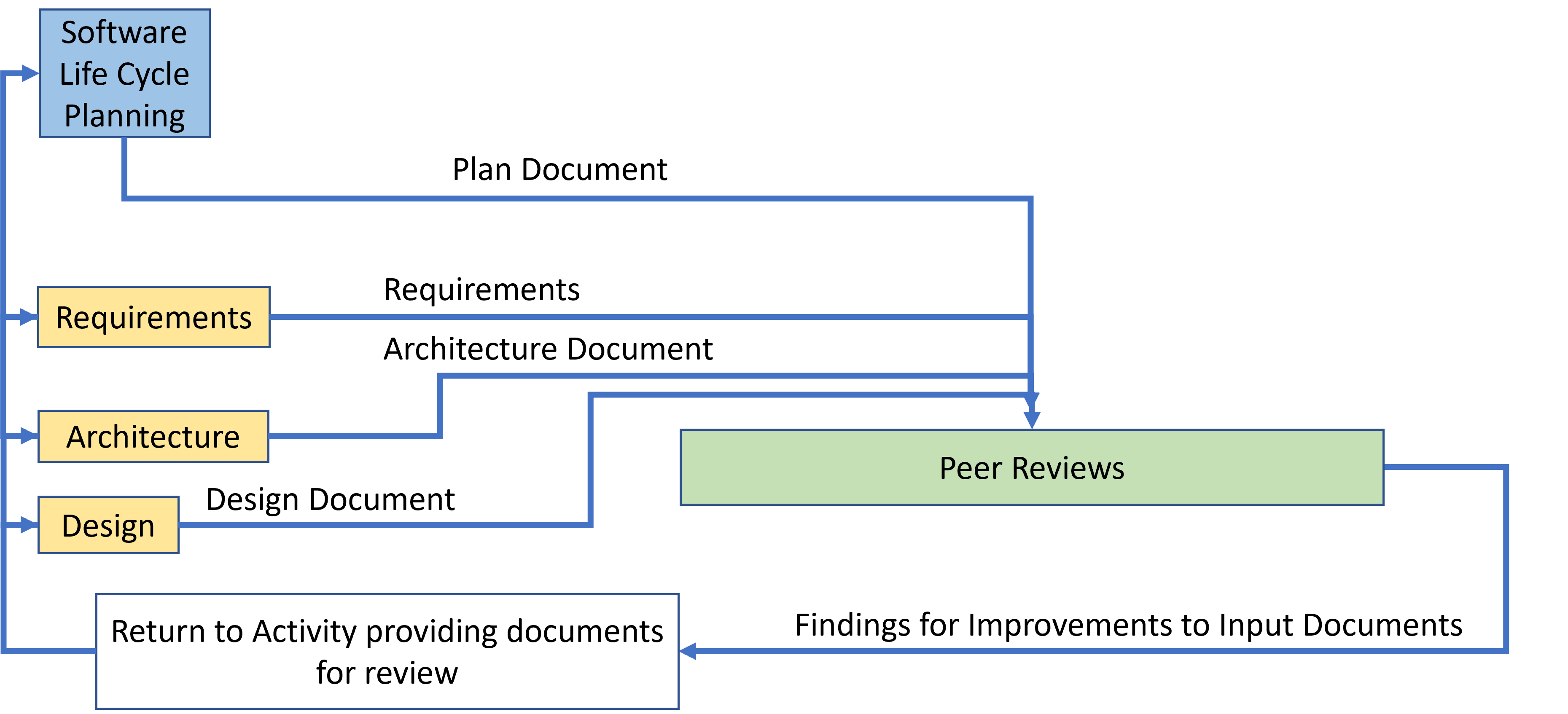
Examples of Some Documents Going Through Peer Review
1.1 Inputs
List of some of the inputs from other activities that are necessary for the activity to begin.
- Planning - Peer Reviews are planned activities. They appear in the plans and schedules for the project
- Requirements - These are the things that are Peer Reviewed
- Architecture Items - These are the things that are Peer Reviewed
- Design items - These are the things that are Peer Reviewed
- Test Plans and Procedures - These are the things that are Peer Reviewed
1.2 Predecessor Activities
List of some of the other activities that must be started (not necessarily completed) this activity to begin.
Predecessor Activities are performed before Peer Reviews. These activities produce the work products that will be reviewed.
- Life Cycle Planning - Peer Reviews are planned activities. They are also used to review and improve all types of plans.
1.3 Outputs
List of some of the outputs or work products of the activity. These are typically used as inputs by the downstream activity. In some cases there is a supporting SWE associated with the work product.
In the case of Peer Reviews, outputs cycle back to the activity that provided the inputs so that improvements to the work products can be made. The activities that initiated the Peer Review, receive the findings from Peer Reviews, Those activities then use those findings to to fix defects and implement improvements uncovered in the reviews. The improved work products are then used by downstream activities as the project proceeds.
| Output Work Product | Used by Downstream Activity |
|---|---|
|
|
1.4 Successor Activities
Links to Activities which might be started or supported by this activity.
- Life Cycle Planning
- Software Architecture
- Software Design
- Software Testing
- Configuration Management
- Coding
1.5 Repetition
Describe what conditions determine if the activity needs to be repeated.
- How much of the activity needs to be repeated
- Frequency of repetition
Peer Reviews are planned activities and may be repeated as needed throughout the life cycle. Certainly as Requirements, budgets, schedules, and technology changes are factored into the project, additional Peer Reviews may be desirable.
2. Defining the Activity
This tab contains the links to pages in the SWEHB that are at the heart of the activity.
2.1 SWEs
This section contains the links to SWE pages that form the heart of the activity.
- SWE-087 - Software Peer Reviews and Inspections for Requirements, Plans, Design, Code, and Test Procedures
- SWE-088 - Software Peer Reviews and Inspections - Checklist Criteria and Tracking
- SWE-089 - Software Peer Reviews and Inspections - Basic Measurements
2.2 Topics and other Supporting Materials
This section is for SWEHB pages, other than SWEs, that directly support the activity. This section contains Topics, document content pages, PATs, and other pages.
2.3 Other Associated SWEs, Topics, etc.
Includes other SWEHB pages that are indirectly associated with the activity. May include SWEs, Topics, document definition pages, PATs, etc. They may have been mentioned in the guidance of another page.
