

UNDER CONSTRUCTION
 View this section on the website
 See edit history of this section
 Post feedback on this section

- 1. Introduction
- 2. Institutional Activities
- 3. Activities
- 4. Distribution of SWEHB Pages
- 5. Activity Page Structure
- 6. Alternative Activity Styles
- 7. Other Considerations
1. Introduction
1.1 Activity Concept
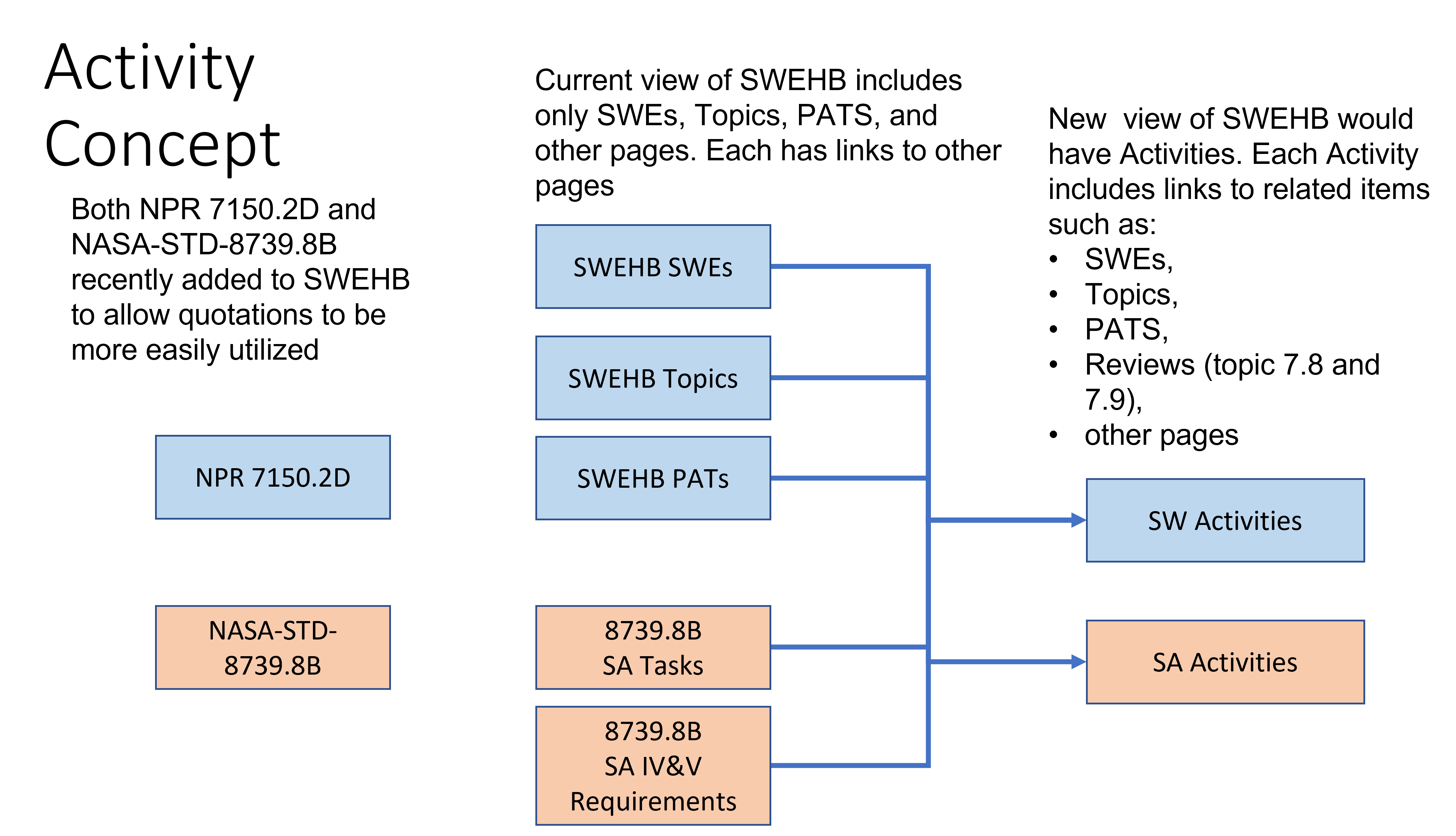
Currently the SWEHB is a collection of pages:
- SWEs - Requirements from NPR 7150.2D along with Rationale, Guidance, Small Projects, Resources, Lessons Learned and Software Assurance, if applicable
- Topics - Additional guidance for appropriate for some SWEs
- PATs - Process Asset Templates - derived from SWEs and Topics
- Other pages - such as Document Contents, FAQs, etc.
Pages include links to other pages based on the relevance of the content on those pages.
The notion of Activity is a natural way to bring together pages from the existing SWEHB into a collection of pages that have a common purpose, an Activity.
1.2 Activity Sequence
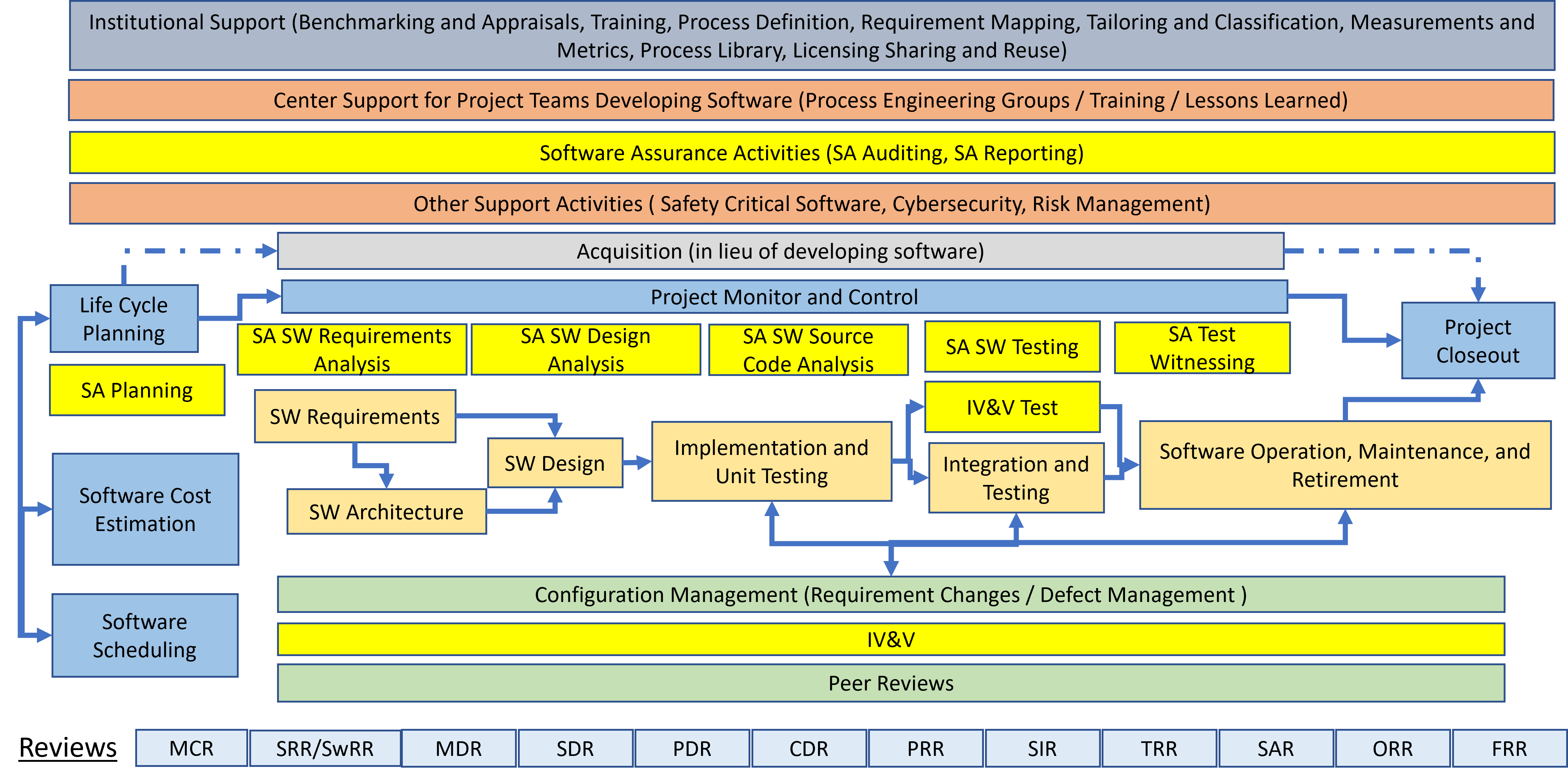
Software Engineering activities are conducted in a predictable sequence. This sequence may be a once through or "waterfall" cycle. Or, it may be an iterative or evolutionary series of cycles which build toward a final product. Regardless of the model chosen, individual activities in all these cycles are very similar.
The major activity groupings here give you a quick way to find guidance in the SWEHB to help you satisfy the needs of the development project while also satisfying the requirements of NPR 7150.2.
The activities associated with Software Development are listed in the tabs of this page. Each tab takes you to a list of links to pages where the activity is is explained in more detail. At the lowest level, there is a list of links to specific pages in the SWEHB where details of the activity are explained and more guidance is provided. In some cases, templates or other Process Assets are included to further help you in conducting the activity.
The diagram below is a visual representation of the activities in a project. Participation by groups such as Institutional Support and Center Support span the whole of the project. the smaller activity boxes represent things that go on for shorter periods of time and as part of a logical sequence. For example, Requirements, Architecture and Design would come before Implementation and Unit Testing. Some activities take place multiple times over the life of a project and occur as needed such as Configuration Management and Peer Reviews. Finally, certain Reviews occur during the life of the project and they are represented at the bottom of the diagram. A timeline is not fixed to this diagram because it varies to suit the needs of the project. The positioning of activities is notional and is, in many cases, repeating. This repetition is accounted for in the project schedule and its updates.
1.3 Activity Groupings
The tabs in this page initially will contain all of the activities in Ch 2 through 5 of NPR 7150.2. This is done to ensure that all SWEs are accounted for.
As the page matures, Topics, PATs, and other resources will be distributed to enrich the content of the activities.
1.4 What Activities ARE and ARE NOT
Activities bring together SWEHB materials that have something in common. In doing this, the activity page brings together links to pages that contain valuable information and guidance about the business of the activity. Activities represent a way of organizing work to make sure that it is performed in a way to ensure the best results. That means, satisfying requirements and achieving mission goals.
It is NOT:
- a list of things that you MUST do - all of the things in an activity such as tasks and work products are suggestions. They are meant to be representative of how you might accomplish the requirements of NPR 7150.2 and the guidance in the Software Engineering Handbook.
- a set of templates and forms that must be filled out -
- extra things that you must do IN ADDITION to the work in your project (requirements, and mission objectives)
2. Institutional Activities
The Institutional Activities include activities associated with OCE, OSMA, and Centers as well as Software Development Project teams. Each activity contains several requirements (from NPR 7150.2D chapter 2) ensuring that higher levels of management establish certain means and infrastructure for projects to use in their projects. In some cases, requirements for Project teams are included describing the use of the management provided resources in their projects.
For example: Management is responsible for providing training for engineers who develop software. Project teams are responsible for ensuring that team members have had this training (in addition to other training on project specific systems and software) so that they may produce high quality software.
2.1 OCE and OSMA Software Engineering Initiative
Agency Level Activities are intended to provide "enabling support" to project teams. These activities include direction, guidance and support to project teams. The requirements describing these activities are found in NPR 7150.2D Chapter 2. The full activity includes some requirements from Chapters 3 through 5 which are the responsibility of the project teams to satisfy. Many of the names for these Activities come directly from NPR 7150.2D. In a few cases, the names are changed to better express the full scope of the Activity.
| Activity Name | Activity Components |
|---|---|
| OCE and SMA benchmarking and determining the capability and maturity of software development groups. Benchmarking techniques derived from CMMI best practices. | |
| Training at all levels from Agency (engineering practices and related training) down to project needs (training for personnel on using development tools). | |
| Development of repeatable processes and practices for OCE, SMA and Center development activities. | |
Determining the applicability of NPR 7150.2 requirements to a particular project. Includes requirements necessary for particular software classifications. Includes SWEs from section 3.5 Software Classification Assessments. | |
Suggested measurements and practices for software projects. NPR 7150.2D para 5.4.1 Software measurement is a primary tool for managing software processes and evaluating the quality of software products. Analysis of measures provides insight into the capability of the software organization and identifies opportunities for software process and product improvements. Software measurement programs at multiple levels are established to meet measurement objectives. The requirements below are designed to reinforce the use of measurement at the project, Center software organization, and NASA Chief Engineer levels to assist in managing projects, assuring quality, and improving software engineering practices. | |
NPR 7150.2D para 2.1.1.6 The NASA OCE shall maintain an Agency-wide process asset library of applicable best practices and process templates for all size projects | |
| Requirements related to the licensing, sharing and reuse of some or all of software products. |
3. Activities
The Software and Assurance activities associated with Software Development Projects are listed as links below.
Each page will contain an activity description and contain links to all the associated SWEs, Topics, PATs, and other pages in the SWEHB that are associated with the activity.
3.1 Software Activity Pages
Links go to existing pages. Underlined (Red in edit mode) links have not yet been created. All activity pages to be children of the Software Project Activities page.
Content structure is contained in the Activity Template.
Project Software Activities
| Activity Name | Activity Components |
|---|---|
| Life Cycle Planning | NPR 7150.2D para 3.1.1 Software life cycle planning covers the software aspects of a project from inception through retirement. The software life cycle planning is an organizing process that considers the software as a whole and provides the planning activities required to ensure a coordinated, well-engineered process for defining and implementing project activities. These processes, plans, and activities are coordinated within the project. At project conception, software needs for the project are analyzed, including acquisition, supply, development, operation, maintenance, retirement, decommissioning, and supporting activities and processes. The software effort is scoped, the development processes defined, measurements defined, and activities are documented in software planning documents. |
| Activity - Software Peer Reviews and Inspections | NPR 7150.2D para 5.3.1 Software peer reviews and inspections are the in-process technical examination of work products by peers to find and eliminate defects early in the life cycle. Software peer reviews and inspections are performed following defined procedures covering the preparation for the review, the review itself is conducted, results are recorded, results are reported, and completion criteria is certified. When planning the composition of a software peer review or inspection team, consider including software testing, system testing, software assurance, software safety, software cybersecurity, and software IV&V personnel. |
| Used when software is acquired or secured from outside sources. | |
| Used for monitoring progress and keeping the project under control through minor adjustments | |
| Used for establishing cost of development of the software products. It includes multiple models and parameters, direct and indirect costs, for the work so that tracking can be effectively done. | |
| Used for establishing and maintaining the development and delivery schedule. Takes into account dependencies on other projects and programs. Includes time for reviews and tracking of issues to resolution, | |
| Ensures that the project follows established processes and practices. Includes audits and corrective actions. | |
| Independent testing and evaluation of software against requirements and performance criteria. Applicable to certain categories of projects. Includes planning, execution of tests and tracking issues and risks to closure. | |
| Includes determining of software is considered safety-critical, and implementing additional requirements to ensure safety of the software product. | |
Evaluation of software requirements and planning for their realization in the final software products. | |
NPR 7150.2D para 4.2.1 Experience confirms that the quality and longevity of a software-reliant system is primarily determined by its architecture. The software architecture underpins a system’s software design and code; it represents the earliest design decisions, ones that are difficult and costly to change later. The transformation of the derived and allocated requirements into the software architecture results in the basis for all software development work. | |
NPR 7150.2D para 4.3.1 Software design is the process of defining the software architecture, components, modules, interfaces, and data for a software system to satisfy specified requirements. The software architecture is the fundamental organization of a system embodied in its components, their relationships to each other and the environment, and the principles guiding its design and evolution. The software architectural design is concerned with creating a strong overall structure for software entities that fulfill the allocated system and software-level requirements. Typical views captured in an architectural design include the decomposition of the software subsystem into design entities, computer software configuration items, definitions of external and internal interfaces, dependency relationships among entities and system resources, and finite state machines. The design should be further refined into lower-level entities that permit the implementation by coding in a programming language. Typical attributes that are documented for lower-level entities include the identifier, type, purpose, function, constraints, subordinates, dependencies, interface, resources, processing, and data. Rigorous specification languages, graphical representations, and related tools have been developed to support the evaluation of critical properties at the design level. Projects are encouraged to take advantage of these improved design techniques to prevent and eliminate errors as early in the life cycle as possible. Software, developed or purchased, has additional requirements to comply with from Section 508 of the Rehabilitation Act, as defined in NPR 2800.2. | |
| NPR 7150.2D para 4.4.1 Software implementation consists of implementing the requirements and design into code, data, and records. Software implementation also consists of following coding methods and standards. Unit testing is also usually a part of software implementation (unit testing can also be conducted during the testing phase). |
Includes integration of modules into a final deliverable package and testing of that package to determine if it is ready for delivery. NPR 7150.2D para 4.5.1 The purpose of testing is to verify the software functionality and remove defects. Testing verifies the code against the requirements and the design to ensure that the requirements are implemented. Testing also identifies problems and defects that are corrected and tracked to closure before product delivery. Testing also validates that the software operates appropriately in the intended environment. Please note for Class A software there are additional software test requirements and software integration requirements as defined in NPR 8705.2. | |
| Final determination of the readiness of the software for release. Includes acceptance testing, and other readiness criteria. |
| Addresses any ongoing maintenance considerations for the software products. NPR 7150.2D para 4.6.1 Planning for operations, maintenance, and retirement are typically considered throughout the software life cycle. Operational concepts and scenarios are derived from customer requirements and validated in the operational or simulated environment. Software maintenance activities sustain the software product after the product is delivered to the customer until retirement. |
| Addresses any ongoing operations considerations for the software products NPR 7150.2D para 4.6.1 Planning for operations, maintenance, and retirement are typically considered throughout the software life cycle. Operational concepts and scenarios are derived from customer requirements and validated in the operational or simulated environment. Software maintenance activities sustain the software product after the product is delivered to the customer until retirement. |
| Addresses any retirement or replacement considerations for the software products NPR 7150.2D para 4.6.1 Planning for operations, maintenance, and retirement are typically considered throughout the software life cycle. Operational concepts and scenarios are derived from customer requirements and validated in the operational or simulated environment. Software maintenance activities sustain the software product after the product is delivered to the customer until retirement. |
Includes control over software products during development along with any associated work products. NPR 7150.2D para 5.1.1 Software Configuration Management (SCM) is the process of applying configuration management throughout the software life cycle to ensure the completeness and correctness of software configuration items. SCM applies technical and administrative direction and surveillance to identify and record the functional and physical characteristics of software configuration items, control changes to those characteristics, record and report change processing and implementation status, and verify compliance with specified requirements. SCM establishes and maintains the integrity of the products of a software project throughout the software life cycle. Use of standard Center or organizational SCM processes and procedures is encouraged where applicable. | |
Planning, monitoring and controlling risks which could impact the software products. NPR 7150.2D para 5.2 Record, analyze, plan, track, control, and communicate all of the software risks and mitigation plans. | |
Identification and tracking of non-conforming products and software. Includes ensuring that defects are removed or fixed. | |
| Includes the closing of projects and dispositioning work products that may need to be used in subsequent projects related to the software products. NPR 7150.2D para 4.6.1 Planning for operations, maintenance, and retirement are typically considered throughout the software life cycle. Operational concepts and scenarios are derived from customer requirements and validated in the operational or simulated environment. Software maintenance activities sustain the software product after the product is delivered to the customer until retirement. |
3.2 Software Assurance Activities
4.1 Software Assurance Description
4.1.1 The Software Assurance activities provide a level of confidence that software is free from vulnerabilities, either intentionally designed into the software or accidentally inserted at any time during its life cycle, that the software functions in an intended manner, and that the software does not function in an unintended manner. The objectives of the Software Assurance and Software Safety Standard include the following:
a. Ensuring that the processes, procedures, and products used to produce and sustain the software conform to all specified requirements and standards that govern those processes, procedures, and products.
(a) A set of activities that assess adherence to, and the adequacy of the software processes used to develop and modify software products.
(b) A set of activities that define and assess the adequacy of software processes to provide evidence that establishes confidence that the software processes are appropriate for and produce software products of suitable quality for their intended purposes.
b. Determining the degree of software quality obtained by the software products.
c. Ensuring that the software systems are safe and that the software safety-critical requirements are followed.
d. Ensuring that the software systems are secure.
e. Employing rigorous analysis and testing methodologies to identify objective evidence and conclusions to provide an independent assessment of critical products and processes throughout the life cycle.
4.1.2 Project and SMA Management support of the software assurance function is essential for software assurance, software safety, and IV&V processes to be effective. The software assurance, software safety, and IV&V support include the following:
a. The Project and SMA Management are familiar with and understand the software assurance, software safety, and IV&V function’s purposes, concepts, practices, and needs.
b. The Project and SMA Management provide the software assurance, software safety, and IV&V activities with skilled resources (people, equipment, knowledge, methods, facilities, and tools) to accomplish their project responsibilities.
c. The Project and SMA Management act upon information provided by the software assurance, software safety, and IV&V function throughout a project.
4.1.3 The Software Assurance and Software Safety Standard’s requirements apply to organizations in their roles as both Acquirers and Providers.
Many of the activities of Software Assurance run parallel to Software Development Activities. In fact, development activities that have specific SA participation have a tab in the SWE specifically for Software Assurance participation.
To further this relationship, the activities below draw on the SA requirements and tasks from NASA-STD-8739.8B and are associated with the SWEs in NPR 7150.2D.
| Activity Name | Activity Components |
|---|---|
Planning of Software Assurance activities in a Software Development Project are done in a collaborative fashion along with the Software Development team. It includes cost estimates and schedules. | |
| Software Assurance tasks found in Development Activities which audit the processes and work products associated with individual SWEs. |
| Software Assurance Analysis tasks in Software Requirements and related activities which further improve the quality of the Software Requirements. Reducing requirement ambiguity, defects, and associated re-work in the of the software. |
| Software Assurance Analysis tasks in Software Design and related activities which further improve the quality of the Software Design. Reducing defects and associated re-work in the design of the software. |
| Software Assurance Analysis tasks in Software Source Code and related activities which further improve the quality of the Software Source Code. Reducing defects and associated re-work in the of the software. |
| Software Assurance Analysis tasks in Software Testing and related activities which further improve the quality of the Software Testing. Improving test coverage, reducing test defects and associated re-work in the of the software. |
| Software Assurance Analysis tasks in Software Reporting and related activities which further improve the overall Software Development Processes. Improving the Development Processes reduces defects and associated re-work in the of the software. |
| Independent testing and evaluation of software against requirements and performance criteria. Applicable to certain categories of projects. Includes planning, execution of tests and tracking issues and risks to closure. | |
| |
|
4. Distribution of SWEHB pages
This tab contains a distribution of SWEs into Activities. Each SWE in the SWEHBVD is in the table. The table lists the Primary Activity in which the SWE is located. Also, for those SWEs that are associated with other activities, the associated activities are listed. This table will be used to distribute the SWEs into activities ensuring that none are lost in the distribution process.
Under Construction in separate spreadsheet. This table will be updated periodically as the spreadsheet is completed.
4.1 SWE pages
| SWE | NPR para | Primary Activity | Associated Activity |
|---|---|---|---|
| SWE-002 - Software Engineering Initiative | 2.1.1.1 | Process Definition | |
| SWE-004 - OCE Benchmarking | 2.1.1.2 | Benchmarking and Appraisals | |
| SWE-152 - Review Requirements Mapping Matrices | 2.1.1.3 | Requirement Mapping, Tailoring, and Classification | |
| SWE-129 - OCE NPR Appraisals | 2.1.1.4 | Benchmarking and Appraisals | |
| SWE-100 - Software Training Funding | 2.1.1.5 | Training | Life Cycle Training |
| SWE-098 - Agency Process Asset Library | 2.1.1.6 | Process Library | |
| SWE-208 - Advancing Software Assurance and Software Safety Practices | 2.1.2.2 | Process Definition | |
| SWE-209 - Benchmarking Software Assurance and Software Safety Capabilities | 2.1.2.3 | Benchmarking and Appraisals | |
| SWE-212 - NASA-STD-8739 Mapping Matrices | 2.1.2.4 | Requirement Mapping, Tailoring, and Classification | |
| SWE-221 - OSMA NPR Appraisals | 2.1.2.5 | Benchmarking and Appraisals | |
| SWE-222 - Software Assurance Training | 2.1.2.6 | Training | Life Cycle Training |
| SWE-223 - Tailoring IV&V project selections | 2.1.2.7 | Requirement Mapping, Tailoring, and Classification | |
| SWE-003 - Center Improvement Plans | 2.1.5.2 | Process Definition | |
| SWE-005 - Software Processes | 2.1.5.3 | Process Definition | |
| SWE-140 - Comply with Requirements | 2.1.5.4 | Requirement Mapping, Tailoring, and Classification | |
| SWE-095 - Report Engineering Discipline Status | 2.1.5.5 | Process Definition | |
| SWE-006 - Center Software Inventory | 2.1.5.6 | Process Definition | |
| SWE-091 - Establish and Maintain Measurement Repository | 2.1.5.7 | Measurements and Metrics | |
| SWE-092 - Using Measurement Data | 2.1.5.8 | Measurements and Metrics | |
| SWE-142 - Software Cost Repositories | 2.1.5.10 | Measurements and Metrics | |
| SWE-144 - Software Engineering Process Assets | 2.1.5.11 | Process Library | |
| SWE-153 - ETA Define Document Content | 2.1.5.12 | Process Library | |
| SWE-215 - Software License Rights | 2.1.5.13 | Licensing, Sharing and Reuse | |
| SWE-216 - Internal Software Sharing List | 2.1.5.14 | Licensing, Sharing and Reuse | |
| SWE-217 - List of All Contributors and Disclaimer Notice | 2.1.5.15 | Licensing, Sharing and Reuse | |
| SWE-214 - Internal Software Sharing and Reuse | 2.1.5.16 | Licensing, Sharing and Reuse | |
| SWE-218 - Contracting Officers | 2.1.7 | Licensing, Sharing and Reuse | |
| SWE-126 - Tailoring Considerations | 2.1.8.2 | Requirement Mapping, Tailoring, and Classification | |
| SWE-150 - Review Changes To Tailored Requirements | 2.2.7 | Requirement Mapping, Tailoring, and Classification | |
| SWE-021 - Transition to a Higher Class | 2.2.8 | Requirement Mapping, Tailoring, and Classification | |
| SWE-033 - Acquisition vs. Development Assessment | 3.1.2 | Acquisition | Life Cycle Planning Software Assurance Planning SA Reporting |
| SWE-013 - Software Plans | 3.1.3 | Life Cycle Planning | SA Planning SA Auditing |
| SWE-024 - Plan Tracking | 3.1.4 | Monitor and Control | Life Cycle Planning Software Assurance Planning SA Reporting SA Auditing |
| SWE-034 - Acceptance Criteria | 3.1.5 | Acceptance and Release | Life Cycle Planning Software Assurance Planning SA Design Analysis SA SW Source Code Analysis SA Reporting |
| SWE-036 - Software Process Determination | 3.1.6 | Life Cycle Planning | Software Assurance Planning |
| SWE-037 - Software Milestones | 3.1.7 | Life Cycle Planning | Software Assurance Planning SA Reporting |
| SWE-039 - Software Supplier Insight | 3.1.8 | Acquisition | Life Cycle Planning Software Assurance Planning SA Auditing |
| SWE-040 - Access to Software Products | 3.1.9 | Life Cycle Planning | Software Assurance Planning |
| SWE-042 - Source Code Electronic Access | 3.1.10 | Life Cycle Planning | Software Assurance Planning |
| SWE-139 - Shall Statements | 3.1.11 | Requirement Mapping, Tailoring, and Classification | Life Cycle Planning SA Planning SA Reporting SA Auditing |
| SWE-121 - Document Tailored Requirements | 3.1.12 | Life Cycle Planning | SA Planning |
| SWE-125 - Requirements Compliance Matrix | 3.1.13 | Life Cycle Planning | SA Planning |
| SWE-027 - Use of Commercial, Government, and Legacy Software | 3.1.14 | Life Cycle Planning | Software Assurance Planning |
| SWE-015 - Cost Estimation | 3.2.1 | Software Cost Estimation | Software Assurance Planning |
| SWE-151 - Cost Estimate Conditions | 3.2.2 | Software Cost Estimation | SA Planning SA Reporting |
| SWE-174 - Software Planning Parameters | 3.2.3 | Software Cost Estimation | |
| SWE-016 - Software Schedule | 3.3.1 | Software Schedules | SA Planning SA Reporting SA Auditing |
| SWE-018 - Software Activities Review | 3.3.2 | Software Schedules | |
| SWE-046 - Supplier Software Schedule | 3.3.3 | Software Schedules | SA Planning |
| SWE-017 - Project and Software Training | 3.4.1 | Training | Life Cycle Planning |
| SWE-020 - Software Classification | 3.5.1 | Requirement Mapping, Tailoring, and Classification | SA Planning |
| SWE-176 - Software Records | 3.5.2 | Requirement Mapping, Tailoring, and Classification | |
| SWE-022 - Software Assurance | 3.6.1 | Software Assurance | |
| SWE-141 - Software Independent Verification and Validation | 3.6.2 | IV&V | |
| SWE-131 - Independent Verification and Validation Project Execution Plan | 3.6.3 | IV&V | |
| SWE-178 - IV&V Artifacts | 3.6.4 | IV&V | |
| SWE-179 - IV&V Submitted Issues and Risks | 3.6.5 | IV&V | |
| SWE-205 - Determination of Safety-Critical Software | 3.7.1 | Safety-Critical Software | SA Reporting |
| SWE-023 - Software Safety-Critical Requirements | 3.7.2 | Safety-Critical Software | |
| SWE-134 - Safety-Critical Software Design Requirements | 3.7.3 | Safety-Critical Software | SA Design Analysis SA SW Requirements Analysis SA SW Source Code Analysis SA Reporting |
| SWE-219 - Code Coverage for Safety Critical Software | 3.7.4 | Safety-Critical Software | |
| SWE-220 - Cyclomatic Complexity for Safety-Critical Software | 3.7.5 | Safety-Critical Software | |
| SWE-146 - Auto-generated Source Code | 3.8.1 | Implementation and Unit Testing | SA Reporting |
| SWE-206 - Auto-Generation Software Inputs | 3.8.2 | Implementation and Unit Testing | Acquisition |
| SWE-032 - CMMI Levels for Class A and B Software | 3.9.2 | Benchmarking and Appraisals | SA Reporting SA Auditing |
| SWE-147 - Specify Reusability Requirements | 3.10.1 | Licensing, Sharing and Reuse | |
| SWE-148 - Contribute to Agency Software Catalog | 3.10.2 | Licensing, Sharing and Reuse | |
| SWE-156 - Evaluate Systems for Security Risks | 3.11.2 | Software Cybersecurity | |
| SWE-154 - Identify Security Risks | 3.11.3 | Software Cybersecurity | |
| SWE-157 - Protect Against Unauthorized Access | 3.11.4 | Software Cybersecurity | |
| SWE-159 - Verify and Validate Risk Mitigations | 3.11.5 | Software Cybersecurity | SA SW Source Code Analysis |
| SWE-207 - Secure Coding Practices | 3.11.6 | Software Cybersecurity | SA SW Source Code Analysis |
| SWE-185 - Secure Coding Standards Verification | 3.11.7 | Software Cybersecurity | |
| SWE-210 - Detection of Adversarial Actions | 3.11.8 | Software Cybersecurity | SA SW Requirements Analysis |
| SWE-052 - Bidirectional Traceability | 3.12.1 | Software Requirements | SA SW Requirements Analysis |
| SWE-050 - Software Requirements | 4.1.2 | Software Requirements | |
| SWE-051 - Software Requirements Analysis | 4.1.3 | Software Requirements | SA SW Requirements Analysis |
| SWE-184 - Software-related Constraints and Assumptions | 4.1.4 | Software Requirements | SA SW Requirements Analysis |
| SWE-053 - Manage Requirements Changes | 4.1.5 | Software Requirements | |
| SWE-054 - Corrective Action for Inconsistencies | 4.1.6 | Software Requirements | SA Reporting |
| SWE-055 - Requirements Validation | 4.1.7 | Software Requirements | |
| SWE-057 - Software Architecture | 4.2.3 | Software Architecture | SA Design Analysis |
| SWE-143 - Software Architecture Review | 4.2.4 | Software Architecture | SA Reporting |
| SWE-058 - Detailed Design | 4.3.2 | Software Design | SA Design Analysis |
| SWE-060 - Coding Software | 4.4.2 | Software Implementation | |
| SWE-061 - Coding Standards | 4.4.3 | Software Implementation | SA SW Source Code Analysis |
| SWE-135 - Static Analysis | 4.4.4 | Software Implementation | SA SW Source Code Analysis |
| SWE-062 - Unit Test | 4.4.5 | Software Implementation | |
| SWE-186 - Unit Test Repeatability | 4.4.6 | Software Implementation | |
| SWE-063 - Release Version Description | 4.4.7 | Software Implementation | |
| SWE-136 - Software Tool Accreditation | 4.4.8 | Software Implementation | |
| SWE-065 - Test Plan, Procedures, Reports | 4.5.2 | Software Testing | |
| SWE-066 - Perform Testing | 4.5.3 | Software Testing | |
| SWE-187 -Control of Software Items | 4.5.4 | Software Testing | |
| SWE-068 - Evaluate Test Results | 4.5.5 | Software Testing | |
| SWE-070 - Models, Simulations, Tools | 4.5.6 | Software Testing | |
| SWE-071 - Update Test Plans and Procedures | 4.5.7 | Software Testing | |
| SWE-073 - Platform or Hi-Fidelity Simulations | 4.5.8 | Software Testing | |
| SWE-189 - Code Coverage Measurements | 4.5.9 | Software Testing | |
| SWE-190 - Verify Code Coverage | 4.5.10 | Software Testing | |
| SWE-191 - Software Regression Testing | 4.5.11 | Software Testing | SA Reporting |
| SWE-192 - Software Hazardous Requirements | 4.5.12 | Software Testing | |
| SWE-193 - Acceptance Testing for Affected System and Software Behavior | 4.5.13 | Software Testing | |
| SWE-211 - Test Levels of Non-Custom Developed Software | 4.5.14 | Software Testing | |
| SWE-075 - Plan Operations, Maintenance, Retirement | 4.6.2 | Operations | SA Reporting |
| SWE-077 - Deliver Software Products | 4.6.3 | Acceptance and Release | SA Auditing |
| SWE-194 - Delivery Requirements Verification | 4.6.4 | Acceptance and Release | |
| SWE-195 - Software Maintenance Phase | 4.6.5 | Maintenance | SA Auditing |
| SWE-196 - Software Retirement Archival | 4.6.6 | Retirement | |
| SWE-079 - Develop CM Plan | 5.1.2 | Software Configuration Management | SA Reporting SA Auditing |
| SWE-080 - Track and Evaluate Changes | 5.1.3 | Software Configuration Management | SA Design Analysis SA SW Requirements Analysis SA SW Source Code Analysis |
| SWE-081 - Identify Software CM Items | 5.1.4 | Software Configuration Management | SA Design Analysis SA SW Requirements Analysis SA SW Source Code Analysis SA Reporting |
| SWE-082 - Authorizing Changes | 5.1.5 | Software Configuration Management | |
| SWE-083 - Status Accounting | 5.1.6 | Software Configuration Management | |
| SWE-084 - Configuration Audits | 5.1.7 | Software Configuration Management | SA Auditing |
| SWE-085 - Release Management | 5.1.8 | Software Configuration Management | SA Auditing |
| SWE-045 - Project Participation in Audits | 5.1.9 | Software Configuration Management | SA Reporting SA Auditing |
| SWE-086 - Continuous Risk Management | 5.2 | Software Risk Management | SA Reporting SA Auditing |
| SWE-087 - Software Peer Reviews and Inspections for Requirements, Plans, Design, Code, and Test Procedures | 5.3.2 | Software Peer Reviews and Inspections | SA SW Requirements Analysis |
| SWE-088 - Software Peer Reviews and Inspections - Checklist Criteria and Tracking | 5.3.3 | Software Peer Reviews and Inspections | SA Auditing |
| SWE-089 - Software Peer Reviews and Inspections - Basic Measurements | 5.3.4 | Software Peer Reviews and Inspections | |
| SWE-090 - Management and Technical Measurements | 5.4.2 | Measurements and Metrics | SA Reporting |
| SWE-093 - Analysis of Measurement Data | 5.4.3 | Measurements and Metrics | SA Reporting |
| SWE-094 - Reporting of Measurement Analysis | 5.4.4 | Measurements and Metrics | |
| SWE-199 - Performance Measures | 5.4.5 | Measurements and Metrics | SA Reporting |
| SWE-200 - Software Requirements Volatility Metrics | 5.4.6 | Software Measurements | SA Reporting |
| SWE-201 - Software Non-Conformances | 5.5.1 | Software Non-conformance or Defect Management | |
| SWE-202 - Software Severity Levels | 5.5.2 | Software Non-conformance or Defect Management | SA Reporting |
| SWE-203 - Mandatory Assessments for Non-Conformances | 5.5.3 | Software Non-conformance or Defect Management | SA Design Analysis SA SW Requirements Analysis SA SW Source Code Analysis |
| SWE-204 - Process Assessments | 5.5.4 | Software Non-conformance or Defect Management | SA Reporting |
4.2 Topic Pages
Includes Recommended Content pages from some of the topic pages.
| Topic # | Activity | Associated Activities |
| 6.1 - Design for Safety Checklist | SA Safety and Hazard Analysis | |
| 6.2 - Checklist for General Software Safety Requirements | SA Safety and Hazard Analysis | |
| 6.3 - Checklist for Choosing a Real Time Operating System (RTOS) | Implementation and Unit Testing | Licensing, Sharing and Reuse Software Design |
| 6.4 - Checklist for Choosing Off-The Shelf Software (OTS) | Implementation and Unit Testing | Licensing, Sharing and Reuse Software Design |
| 6.5 - Checklist for C Programming Practices | Implementation and Unit Testing | |
| 6.6 - Checklist for C++ Programming Practices | Implementation and Unit Testing | |
| 6.7 - Checklist for Ada Programming Practices | Implementation and Unit Testing | |
| 6.8 - Checklist for Fortran Programming Practices | Implementation and Unit Testing | |
| 6.9 - Checklist for Generic (Non-Language-Specific) Programming Practices | Implementation and Unit Testing | |
| 6.10 - Checklist for General Good Programming Practices | Implementation and Unit Testing | |
| 6.11 - Examples of Programming Practices for Exception Handling | Implementation and Unit Testing | |
| 7.1 - History and Overview of the Software Process Improvement (SPI) Effort | Process Definition | |
| 7.2 - Classification and Safety-Criticality | Requirement Mapping, Tailoring, and Classification | |
| 7.3 - Acquisition Guidance | Acquisition | |
| 7.4 - Flowdown of NPR Requirements on Contracts and to Other Centers in Multi-Center Projects | Life Cycle Planning | - Acquisition - Requirement Mapping, Tailoring, and Classification |
| 7.5 - Work Breakdown Structures That Include Software | Software Scheduling | Cost Estimation |
| 7.6 - Software Test Estimation and Testing Levels | Software Scheduling | - Cost Estimation - Implementation and Unit Testing - Integration and Testing |
| 7.7 - Software Architecture Description | Software Architecture | |
| 7.8 - Maturity of Life-Cycle Products at Milestone Reviews | Software Scheduling | Life Cycle Planning |
| 7.9 - Entrance and Exit Criteria | Software Scheduling | Life Cycle Planning |
| 7.10 - Peer Review and Inspections Including Checklists | Peer Reviews and Inspections | |
| 7.11 - SWE History | n/a | |
| 7.12 - Retired | n/a | |
| 7.13 - Transitioning to a Higher Class | Requirement Mapping, Tailoring, and Classification | |
| 7.14 - Implementing Measurement Requirements and Analysis for Projects | Measurements and Metrics | |
| 7.15 - Relationship Between NPR 7150.2 and NASA-STD-7009 | Software Architecture | - Software Design -Integration and Testing |
| 7.16 - Appendix C. Requirements Mapping and Compliance Matrix | Requirement Mapping, Tailoring, and Classification | |
| 7.17 - 7150.2C Appendices (Definitions, References, etc.) | n/a | |
| 7.18 - Documentation Guidance | n/a | |
| CR-PR - Software Change Request - Problem Report | Non-Conformance and Defect Management | |
| IDD - Interface Design Description | Software Architecture | Software Design |
| Inspect - Software Inspection, Peer Reviews, Inspections | Peer Reviews and Inspections | |
| Maint - Software Maintenance Plan | Maintenance | |
| Metrics - Software Metrics Report | Measurements and Metrics | |
| SCMP - Software Configuration Management Plan | Configuration Management | |
| SDD - Software Data Dictionary | Software Design | |
| SDP-SMP - Software Development - Management Plan | Life Cycle Planning | |
| SRS - Software Requirements Specification | Software Requirements | |
| STP - Software Test Plan | Integration and Testing | |
| STR - Software Test Report | Integration and Testing | |
| SUM - Software User Manual | Operations | Acceptance and Release |
| SwDD - Software Design Description | Software Design | |
| Test - Software Test Procedures | Integration and Testing | |
| Train - Software Training Plan | Training | |
| VDD - Version Description Document | Acceptance and Release | |
| 7.19 - Software Risk Management Checklists | Risk Management | |
| 7.20 - Assessing - Meets the Intent | Risk Management | |
| 7.21 - Multi-condition Software Requirements | Integration and Testing | Safety-Critical Software |
| 8.1 - Off Nonimal Testing | SA SW Testing Analysis | SA SW Testing Analysis |
| 8.2 - Software Reliability | SA SW Testing Analysis | |
| 8.3 - Organizational Goals of Software Assurance Metrics | Measurements and Metrics | |
| 8.4 - Additional Requirements Considerations for Use with Safety-Critical Software | SA Safety and Hazard Analysis | |
| 8.5 - SW Failure Modes and Effects Analysis | SA SW Requirements Analysis | SA Safety and Hazard Analysis |
| 8.6 - IV&V Surveillance | IV&V | Acquisition |
| 8.7 - Software Fault Tree Analysis | SA Safety and Hazard Analysis | |
| 8.8 - COTS Software Safety Considerations | SA Safety and Hazard Analysis | |
| 8.9 - Software Safety Analysis | SA Safety and Hazard Analysis | |
| 8.10 - Facility Software Safety Considerations | SA Safety and Hazard Analysis | |
| 8.11 - Auto-Generated Code | Implementation and Unit Testing | |
| 8.12 - Basics of Software Auditing | SA Auditing | |
| 8.13 Test Witnessing | SA SW Testing Analysis | SA Auditing |
| 8.14 SA Tasking for NPR 7150.2B | ? | |
| 8.15 - SA Tasking Checklist Tool | ? | |
| 8.16 - SA Products | n/a | |
| Audit Reports | SA Reporting | |
| Checklists and Guidance Lists | n/a | |
| IV&V Program Execution Plan | SA Planning | IV&V |
| Objective Evidence | All SA Activities | |
| Software Assurance Plan | SA Planning | |
| Software Assurance Status Reports | SA Reporting | |
| Software Design Analysis | SA Design Analysis | |
| Software Requirements Analysis | SA SW Requirements Analysis | |
| Software Safety and Hazard Analysis | SA Safety and Hazard Analysis | |
| Source Code Quality Analysis | SA SW Source Code Analysis | |
| Testing Analysis | SA SW Testing Analysis | |
| 8.17 - Software Safety Audit Checklists | SA Auditing | |
| 8.18 - SA Suggested Metrics | Measurements and Metrics | |
| 8.19 - Dead / Dormant Code and Safety Critical Software | Licensing, Sharing and Reuse | - SA Safety and Hazard Analysis - Software Design |
| 8.20 - Safety Specific Activities in Each Phase | SA Safety and Hazard Analysis | |
| 8.21 - Software Hazard Causes | SA Safety and Hazard Analysis | |
| 8.22 - Hazardous Commands | SA Safety and Hazard Analysis | |
| 8.23 - Software Contents of a Certification of Flight Readiness | Acceptance and Release | |
| Software Design Principles | Software Design | SA Design Analysis |
| Software Safety and Design Principles | SA Design Analysis | Software Design |
| Coding Standards | Software Design | SA Design Analysis |
| Command Receipt Acknowledgement | Software Design | SA Design Analysis |
| Data Interface Integrity | Software Design | SA Design Analysis |
| Dead Code Exclusion | Software Design | SA Design Analysis |
| Fault Detection and Response | Software Design | SA Design Analysis |
| Flight Software Modification | Software Design | SA Design Analysis |
| Incorrect Memory Use or Access | Software Design | SA Design Analysis |
| Initialization - Safe Mode | Software Design | SA Design Analysis |
| Invalid Data Handling | Software Design | SA Design Analysis |
| Resource Margins | Software Design | SA Design Analysis |
| Resource Oversubscription | Software Design | SA Design Analysis |
| Resource Usage Measurement | Software Design | SA Design Analysis |
| Safe Transitions | Software Design | SA Design Analysis |
| Thread Safety | Software Design | SA Design Analysis |
4.3 PAT Pages
4.4 Other Pages
Add page/groups from 8739.8B
- SA Tasks
- IV&V Overview and Requirements
- SA Tailoring Standard Requirements
5. Activity Page Structure
We will need to decide how to consistently display information about activities. Since we have two groups involved with the Activity pages. There are multiple ways of displaying the information related to an Activity.
5.1 Common Elements in the Activity Structure
| Tab | Title | Content |
| 1 | Introduction | Brief description of the activity and its scope. If applicable, a quote from the NPR or STD is used to amplify the description. |
| 1.1 | Inputs | List of some of the inputs from other activities that are necessary for the activity to begin. |
| 1.2 | Predecessor Activities | List of some of the other activities that must be started (not necessarily completed) so that this activity may begin. |
| 1.3 | Outputs | List of some of the outputs or work products of the activity. These are typically used as inputs by the downstream activity. In some cases there is a supporting SWE associated with the work product. |
| 1.4 | Successor Activities | Links to Activities which might be started or supported by this activity. |
| 1.5 | Activity Repetition | Describe what conditions determine if the activity needs to be repeated, such as re-planning after a change in requirements or schedule constraints.
|
| 1.6 | Center Resources from SPAN | Add links to SPAN activity pages that are appropriate for this activity. Use links from the Activity section of the SPAN front page. SPAN. This further differentiates SWEHB from SPAN in the sense that PATs are templates derived from SWEHB guidance, SPAN assets and templates are Center defined and developed resources. |
| 2 | Defining Software Development Activity | This tab contains the links to pages in the SWEHB that are at the heart of the activity. |
| 2.1 | SWEs | This section contains the links to SWE pages that form the heart of the activity. |
| 2.2 | Topics and other Supporting Materials | This section is for SWEHB pages, other than SWEs, that directly support the activity. This section contains Topics, document content pages, PATs, and other pages.
|
| 2.3 | Other Associated SWEs, Topics, etc. | Includes other SWEHB pages that are indirectly associated with the activity. May include SWEs, Topics, document definition pages, PATs, etc. They may have been mentioned in the guidance of another page. This section may be removed if there is no content for it. |
| 3 | Defining SA Activity | This tab contains the links to pages in the SWEHB that are at the heart of the activity. |
| 3.1 | SWEs | This section contains the links to SWE pages that form the heart of the activity. |
| 3.2 | Topics and other Supporting Materials | This section is for SWEHB pages, other than SWEs, that directly support the SA activity. This section contains Topics, document content pages, PATs, and other pages.
|
| 3.3 | Other Associated SWEs, Topics, etc. | Includes other SWEHB pages that are indirectly associated with the activity. May include SWEs, Topics, document definition pages, PATs, etc. They may have been mentioned in the guidance of another page. This section may be removed if there is no content for it. |
5.1 Combined Format
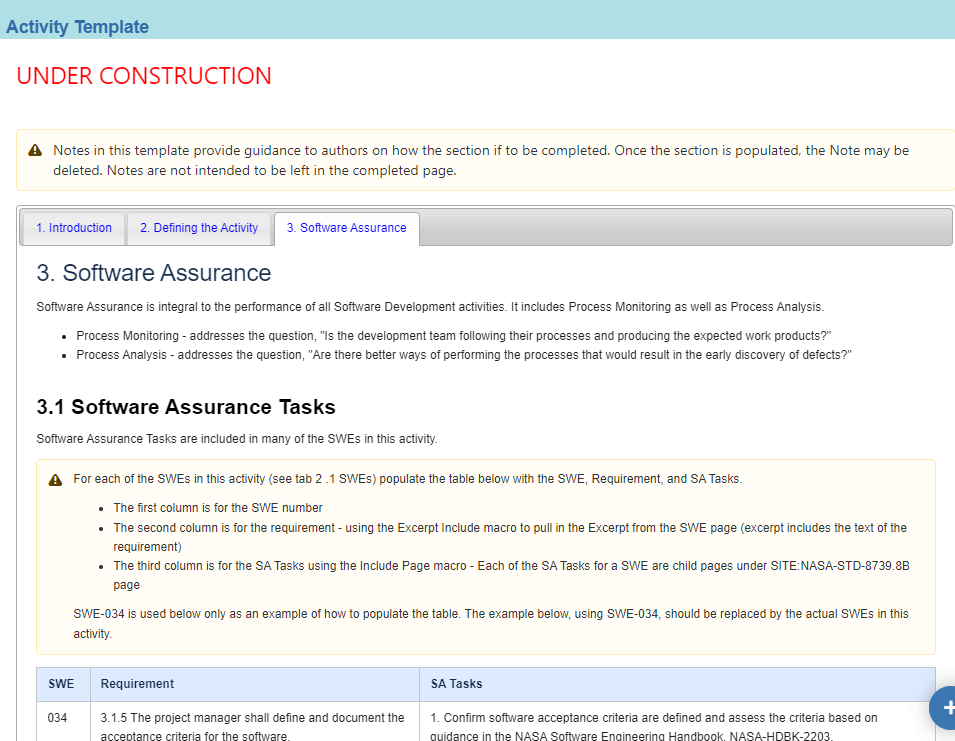
In the combined format, Activities that are closely related such as Planning may have a combined format. Tab 2 information is associated with both Software Engineering and Software Assurance content. An additional tab is provided to include SA tasks (from the included SWEs) that apply to the activity.
A risk associated with this way of displaying Activity information is that it may be difficult to easily pick out the SA pieces from the Engineering pieces of an activity. It will be critical to specify who is involved in each element of the activity. An example of this can be found in Planning where the Engineering and Assurance elements of the activity run in parallel and have considerable overlap. Engineering will plan certain processes and then Assurance will plan the auditing of those processes.
5.2 Separate Formats
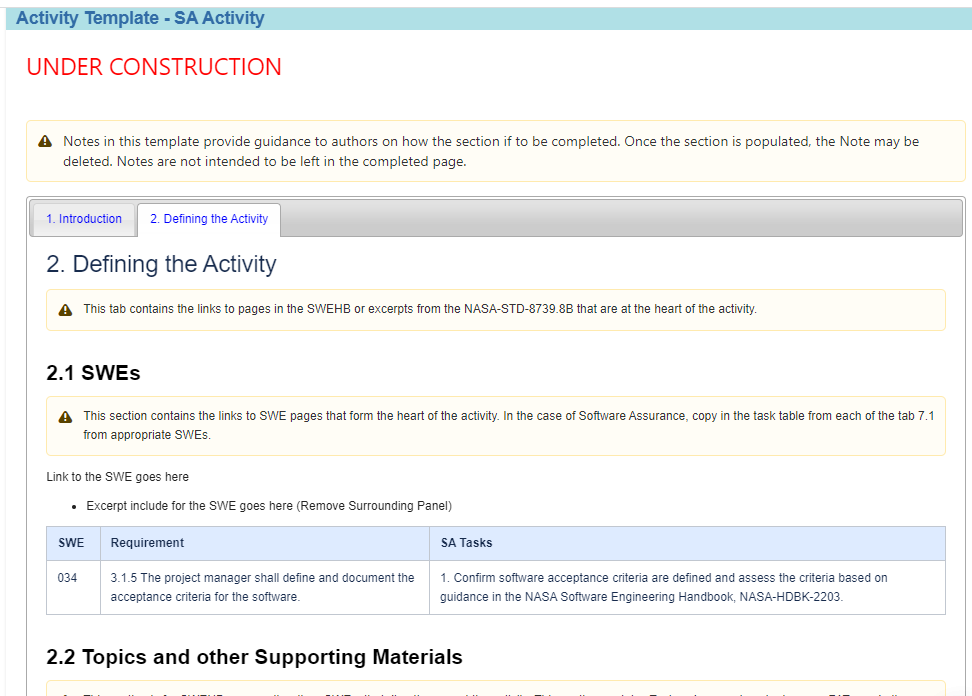
In separate formats, there is only one template. The indication of who is performing the activity is indicated in the title of the Activity. In this example, SA activities include the SA Task lists from the associated SWEs. Software Engineering Activities would not have SA Tasks displayed in section 2.1.
6. Alternative Activity Styles
The Activity is a new concept for organizing content in SWEHB. In this tab, we explore various ways to display activity content while keeping several requirements in mind:
- minimize the creation of new content by reusing existing content as much as possible.
- minimize training necessary to use the activity, it should be obvious how to use the activity and its information
- make the activity inclusive so that Software Developers and Software Assurance and others can use it easily
6.1 Initial Reactions to First Two Templates
At our 12/13/2023 meeting, there was some discussion about the organization and content of the two templates reviewed. It was not clear how these templates would accomplish the inclusivity requirement above. In this tab, we will explore some alternatives to these first two templates to attempt to get an Activity organization that satisfies all of the requirements.
6.2 Existing Structure in SWEs with Tab 7 Software Assurance
SWEs that are from Chapters 3 through 5 of NPR 7150.2D have a Tab 7 for Software Assurance content. The tab 7 information defines a structure for providing guidance to Software Assurance team members for satisfying a SWE. This tab brings into focus the parallel nature of Software Assurance and Software Development work. For every requirement in NPR 7150.2, chapters 3 through 5, for Software Development, there are some tasks for Software Assurance to accomplish. The organization of tab 7 is:
- Tasking for Software Assurance - one or more tasks derived from the NPR 7150.2 Requirement and specifically included in NASA-STD-8739.8.
- Software Assurance Products - one or more work products created as a result of accomplishing the tasking.
- Metrics - example metrics that could be collected (including some that must be collected) as a result of accomplishing the tasking.
- Guidance - Additional information regarding how the tasks could be accomplished. In some cases, the guidance includes step by step instructions on accomplishing the tasks.
Using SWE-058 as an example, we see 5 tasks assigned to SA:
1. Assess the software design against the hardware and software requirements and identify any gaps.
2. Assess the software design to verify that the design is consistent with the software architectural design concepts and that the software design describes the lower-level units to be coded, compiled, and tested.
3. Assess that the design does not introduce undesirable behaviors or unnecessary capabilities.
4. Confirm that the software design implements all of the required safety-critical functions and requirements.
5. Perform a software assurance design analysis.
6.3 Expanding the Notion of Tasking into the SWE Structure
For this example, we will work with the page: Copy of SWE-058 - Detailed Design with new tab 4 .
If we consider expanding the notion of Tasks into the current SWEs, we would have to look for a place to put them. Without a major restructuring of the tabs, we could consider putting them into tab 4. This would require renaming this tab from "Small Projects" to something like "Project Tasks". Initially, we may leave the existing text in tab 4 and just add to it. The preamble for this tab might be:
"Project Tasks are recommended for projects where this SWE is applicable. They are derived from the requirement. Suggestions for completing the tasks and producing the recommended work products are based on the guidance in tab 3."
The Guidance for SWE-058 contains information which could be interpreted as tasks for Software Development team members. After putting appropriate subheadings into tab 3, we have the following collection:
- 3.1 Design Readiness - including suggested checklist items for preparing for a Preliminary Design Review (PDR)
- 3.2 Coding Standards and Processes
- 3.3 Design Considerations
- 3.4 Detailed Design Documentation and Progress Reviews
- 3.5 Design Maintenance
For the new tab 4 content we might consider the following:
4.1 Tasking for Software Development
Guidance for each task is available in tab 3.
- Assess Design Readiness
- Establish Coding Standards and Processes
- Establish Project Specific Design Considerations
- Establish Detailed Design Documentation and Progress Reviews
- Establish Design Maintenance Processes and Mechanisms
4.2 Software Development Work Products
- SwDD - Software Design Description
- Minimum recommended content for a Software Design Description.
- Preliminary at PDR - 7.9 - Entrance and Exit Criteria (tab 7)
- Baselined at CDR - 7.9 - Entrance and Exit Criteria (tab 8)
- Updated at TRR - 7.9 - Entrance and Exit Criteria (tab 11)
- IDD - Interface Design Description
- Minimum recommended content for the Interface Design Description.
- Preliminary at PDR - 7.9 - Entrance and Exit Criteria (tab 7)
- Baselined at CDR - 7.9 - Entrance and Exit Criteria (tab 8)
- Updated at TRR - 7.9 - Entrance and Exit Criteria (tab 11)
- SUM - Software User Manual
- Minimum recommended content for the Software User Manual.
- Baselined at ORR - 7.9 - Entrance and Exit Criteria (tab 13)
- Software Development Process - which includes details on the Design Process to be followed.
- List of design components including when they are expected to be available - as input to Development Schedule
- List of methods, tools, standards, and guidelines for your project.
- List of training and experience required by team members to perform the design and development work.
- ....
4.3 Metrics
Suggested metrics are listed below. Items in bold are strongly recommended for implementation in order to provide benefit for tracking and assessing completion of the work.
- # of architectural issues identified vs. number closed.
- # of design issues found versus the number of design issues resolved.
- # of requirement issues (Open, Closed) over time.
- # of non-conformances identified by life cycle phase over time.
- # of software work product Non-Conformances identified by life cycle phase over time
This tasking was derived using
- The headings from the guidance in tab 3 for the tasks
- Three of the work products are mentions specifically and have minimum document structure topics to work from. These documents also have specific points in the life cycle where they are needed for reviews. All of that detail is delineated here.
- Some of the other work products found in tab 3 (not an exhaustive list here, just enough to represent the concept)
- Metrics are taken from 7.3 (SA Metrics) and reworded slightly (again, not an exhaustive list here, just enough to represent the concept)
6.4 Comparing Tasks
Looking at the Development Tasks above, it is clear that there is not a one to one correspondence between Development Tasks and Assurance Tasks. The table below demonstrates this:
| Development Task | Assurance Task |
|---|---|
| 1. Assess the software design against the hardware and software requirements and identify any gaps. 2. Assess the software design to verify that the design is consistent with the software architectural design concepts and that the software design describes the lower-level units to be coded, compiled, and tested. 3. Assess that the design does not introduce undesirable behaviors or unnecessary capabilities. 4. Confirm that the software design implements all of the required safety-critical functions and requirements. 5. Perform a software assurance design analysis. |
A similar disparity can be seen with the Work products for the two areas:
| Development Work Products | Assurance Work Products |
|---|---|
|
|
When building the Combined activity it will be necessary to have tabs for both Development and Assurance.
6.5 Activity View of Software Design Activity
One approach to this might be to combine the Development and Assurance elements into a single activity to reinforce the notion that the two groups are expected to work in a coordinated way even though not in a closely coupled way. To show this, look at the Activity - Software Design - Combined page. This page shows the combination of Development Tasks and Assurance Tasks in a single activity.
The activity "Software Design" was selected because it has only one SWE associated with it. Only one SWE is needed to show how it develops in the sections of the activity. It is more straight forward that trying to develop an activity like "Life Cycle Planning" which has many SWEs.
The content for each tab is listed here. in order to avoid duplicating a lot of text, the existing SWEs and Topics are referenced and linked as much as possible. A minimal amount of text is copied into the Activity page. In many cases, excerpts are used to bring text in. This will minimize the original authoring of a lot of text.
6.5.1 Tab 1 Introduction
This section contains a quote from NPR 7150.2D to describe what the activity is all about. If a quote is not available (it was not defined in the NPR) then new text must be provided to describe the activity.
- Inputs, Outputs and Predecessor Activities - this introduces the flow chart for the activity. The flow chart is notional and not intended to be exhaustive in describing ALL of the possible inputs, outputs, and Predecessors. Currently the charts are derived from the master chart showing the overall flow of a Software Development project. It is contained in a PowerPoint presentation and images are saved as .PNG files. These files are then attached to the activity so that they may be displayed on the activity page.
- 1.1 Inputs - provides a section for listing the major inputs to the activity. They represent documents, plans, etc. that are used in the activity. They may not need to be completed inputs but need to be complete enough so that meaningful progress on the activity can take place.
- 1.2 Predecessor Activities - These are other major activities that must have at least started before the activity can be started.
- 1.3 Outputs - These are some of the major work products that will come out of the activity. Many of these work products will go through peer review cycles prior to use in subsequent activities.
- 1.4 Successor Activities - These are some of the activities that will be started after the activity is at least started. Some of these activities depend on one or more of the work products listed in the Outputs.
- 1.5 Activity Repetition - This section describes how often the activity is performed. All activities are performed once. Many are performed additional times depending on certain triggers such as requirements changes, budget changes, technology changes, etc.
- 1.6 Center Resources from SPAN - This section acknowledges the role of the Centers in providing libraries of process assets aimed at facilitating the performance of these activities. SWEHB builds asset prototypes from guidance on satisfying requirements, The Center assets are built on experience in satisfying the requirements on actual projects. Links to the appropriate asset pages in SPAN are provided.
6.5.2 Tab 2 Software Development Activity
This section focuses on SWEHB components aimed as supporting the Software Development Community. It organizes components into groups of page types.
- 2.1 SWEs - in NPR 7150.2D many of the SWEs are grouped together in activities. These groupings are preserved here and in some cases expanded upon. Planning, Peer Reviews, and Software Design are some examples of activities right from the NPR. In this section, each SWE is listed including:
- The title of the SWE (as a link to the SWE page)
- Below the SWE title is a list of the tasks. Tasks are derived from the guidance on the SWE page. In some cases, this is simple because the tasks come from the subheadings in the guidance. In other cases, they may need to be derived from a review of the guidance text.
- 2.2 Topics and Other Supporting Materials - this section contains links to other pages in the SWEHB that contain material relevant to the activity.
- In both the Topics and Supporting Materials sub-sections, the title is presented as a link to the page.
- Some are obvious by their titles, like, 7.7 - Software Architecture Description. Others are less obvious.
- Some may even apply to multiple activities. For example, a checklist for building a work product for an activity may also be used in performing a peer review of that work product.
- Some are links to document structures (most of these are collected under in topic 7.18)
- Some are Process Asset Templates (PATs) - these are prototype assets built from the SWE guidance and intended to serve as a starting point for projects to use. Projects are encouraged to improve upon the content of the template to help their project.
- Below the title link is the page excerpt. Most pages have an excerpt which describes in a sentence or two what the page is all about.
- In both the Topics and Supporting Materials sub-sections, the title is presented as a link to the page.
- 2.3 Other Associated SWEs, Topics, etc. - this is a catchall for other pages which are indirectly associated with the activity. In some SWEHB pages other SWEs are referenced and may be helpful to be included here.
6.5.3 Tab 3 Software Assurance Activity
This tab brings out the relationship between Software Development and Software Assurance for the activity. Where tab 3 in the SWE provides guidance for Software Developers on how to satisfy the requirement, tab 7 provides guidance for Software Assurance on how to satisfy the requirement.
- 3.1 Software Assurance Tasks from SWEs - Tasking in tab 7 of the SWEs comes directly from NASA-STD-8739.8B. It is reproduced in this section of the tab for each SWE.
- The title of the SWE is listed as a link to the page.
- Tasking from tab 7 (NASA-STD-8739.8B) is listed.
- Software Assurance Products are listed
- Metrics are listed
- The title of the SWE is listed as a link to the page.
- 3.2 Topics and Other Supporting Materials - other SWEHB pages that describe Software Assurance activities.
- The title of the topic page is given as a link
- The excerpt from the topic page is displayed
- For PATs, the title of the PAT is given as a link to the page
- The excerpt from the page is displayed. For a PAT, this is n image of the first page of the PAT. The image is linked to the PAT template document.
- There are some applicable topic pages that differ in their content. These are associated with topic 8.16. They contain content very similar to an activity in that it brings together tasks from multiple SWEs.
- The title of the page is given as a link
- The excerpt from the page is displayed
- Related SWEs are listed along with tasking
- The title of the page is given as a link
- The title of the topic page is given as a link
- 3.3 Other Associated SWEs, Topics, etc. - this is a catchall for other pages which are indirectly associated with the activity. In some SWEHB pages other SWEs are referenced and may be helpful to be included here. It may be added if needed.
6.6 Special Topics Pages That Seem To Mimic Activities
In building the third Activity example, Activity - Software Design - Combined, It became apparent that there are some new pages in the SWEHB tat are different from the typical SWE or Topic. In the latter days of SWEHBVC some work was done on a small number of pages in the 7.18 - Documentation Guidance. They were moved into Topic 8.16 - SA Products. As these pages developed further, they became more than just a "minimum content" description. They blossomed into very detailed guidance pages, looking somewhat like activity descriptions.
These pages have sections for:
- Listings of SA tasking from multiple SWEs
- Guidance for performing the tasks. Including:
- checklists and PATs for the tasks
- descriptions of interfaces with other entities such as SARB
- descriptions of various reviews
- techniques
- recommended content for various types of reports
- Guidance for performing Safety Analysis, Hazard Analysis, etc.
- Analysis Reporting Content
- Safety related content
- Tasks needing Objective Evidence
Certainly, all of these pages and content are valuable as topics for providing guidance on performing all types of work related activities. It may be somewhat of a challenge to accurately represent all of this content in the Activity format. Part of the concern is that it is currently under development and changes to the content will require that the Activities which point to them will need maintenance to keep up with the development in these areas. We will have to look carefully at these topics and come up with a way to include their content in Activities without getting too exhaustive in the Activity. Case in point,
- In my attempt to be inclusive in my Activity - Software Design - Combined page, I may have too much detail in section 3.2 where I go down to the task level on the 8.55 - Software Design Analysis page.
- Conversely, there may not be enough detail in the activity to cover other tabs in the 8.55 - Software Design Analysis page such as:
- Safety Analysis During Design
- Analysis Reporting Content
6.7 Reworking Peer Reviews into the Combined Activity Format
The combined format and the reworking of tab 4 in SWEs (to bring out Software Development tasks, work products and metrics) dramatically increased the content in the Design activity. Doing the same thing for Peer Review shows some additional interesting things.
Copies of the three SWES in the Peer Review Activity were made and the tab 4 in each was expanded after the tab 3 was reworked with sub-headings. Then the combined activity for Peer Review was built.
- Copy of SWE-087 - Software Peer Reviews and Inspections for Requirements, Plans, Design, Code, and Test Procedures
- Copy of SWE-088 - Software Peer Reviews and Inspections - Checklist Criteria and Tracking
- Copy of SWE-089 - Software Peer Reviews and Inspections - Basic Measurements
- Activity - Software Peer Reviews and Inspections - Combined
6.7.1 Removing Metrics From The Template
Tab 1 of the activity did not change much from the previous examples of this activity. Significant changes needed to be made in tabs 2 and 3. In both tabs 2 and 3 the metrics detail is gone. It was deleted because there was too much detail and it made the presentation of the activity too confusing.
| What is there | What is missing |
|---|---|
|
|
| |
|
|
|
6.7.2 Addition of "Clarifying Statement"
Note the addition of "Another clarifying statement to further describe the SWE" in tab 1. This was added because the excerpt for a SWE page is the requirement. It does not contain any "reusable text" describing the purpose of the page. In the case of the Peer Review SWEs, reworking the guidance tabs made it clear why the three SWEs were needed:
- SWE-087 - Establishes the Peer Review Process to be used in the project
- SWE-088 - Establishes individual Peer Review content for each of the documents to be reviewed
- SWE-089 - Establishes Metrics for the Process as well as the individual reviews
This distinction between the SWEs was not brought out in the Rationale statements. Expressing them in the activity add some clarity for the user.
6.7.3 Summarizing the Combined Activity Structure
There are several features of the combined structure. whether they are net positives or net negatives will be for us to debate. We need to consider several questions for each. Some of these items imply a significant amount of work to get the SWEs and Topics ready for the reorganization. There is a lot of work remaining to get the PATs configured and made available.
- Combining the Development and Assurance activities
- Does it reinforce the concept of "working together"
- Are the tasks for Development and Assurance so different that they lead to confusion or do they serve to bring the work to a logical conclusion?
- Omitting Metrics from the Combined Activity page
- Since Metrics are in the SWE page, tab 4 and 7, they are unnecessary clutter in the Activity page?
- Are a few of the key metrics desirable to have in the Activity to ensure that the whole reason for having Metrics is not lost?
- Clarifying statements and Tab 2 in the SWEs
- Should the clarifying statements be consolidated in the Tab 1 to explain why there are so many SWEs on this subject?
- Should the rationale statements in the SWEs be updated to explain how the collection of related SWEs work together?
- Updating in Tab 3 - adding subheadings to clarify tasks. Much of the content is well organized, this is just adding subheadings that make the tasking more obvious
- Is it appropriate to say that Development teams have "tasking" imposed on them by the NPR? Is that a Center responsibility through their Asset Libraries and SEPG organizations?
- Updating in Tab 4 - Adding Tasking, Work Products, and Metrics
- Is it okay to leave the Small Projects content in at the top of the page?
- Should Small Projects be move elsewhere? Does it need it's own sub-heading
- Divergence through content coming out of 8.16 topics
- Is there a close alignment of all the 8.16 topics with the development requirements of the SWEs.
- Some of the 8.16 topics span a wide range of SWEs as in "Topic 8.16 - Software Design Analysis", tasks reach out beyond Design.
- Completing the creation of PATs - there are just over 30 now, There are probably as many as a hundred total depending on how we want to break out some of the SWE content that is currently in bulleted lists in tabs.
- Should we prioritize the creation of PATs over the creation of activities?
- Are the Activities more important than the PATs?
- Are they of equal importance - build PATS as the content in Tab 3s are updated?
- Rollout of Activity in the reorganization
- Should it be done all at once, individually, or in some sort of logical groupings?
- How should the Activity reorganization be coordinated with other things like Blog postings - Blog postings could be the announcement mechanism for letting the community know about the various updates.
6.7.4 Key Points for the Presentation at KSC in February
- What are the key things that we want to keep in the new structure?
- What are the things that we need to rethink?
- How much should we be reveling to the SWWG at the meeting in February?
- What things are we needing input on from the SWWG to influence the changes to the SWEHB?
- What items can we say we are rolling out at the meeting?
- Blogs
- Reorganization of the Requirements buttons
- Creation of the Activity button
- Reorganization of Topics - uniform numbering of topics
- Updating Acronyms and Terms in accordance with NPR 7150.2 and NASA-STD-8739.8
7. Other Considerations For Activities
7.1 Readiness Reviews in Activities
Topic 7.09 - Entrance and Exit Criteria covers a number of reviews that occur at the completion of certain activities.
- Should these reviews be accounted for in the activities?
- Are they activities by themselves?
- Do we need PATS for each of these reviews?
- Could be a single PAT for each review or 3 PATS (Entrance Criteria, Materials for Review, Exit Criteria) for each review.
7.2 Life Cycle Products
Topic 7.08 - Maturity of Life Cycle Products at Milestone Reviews covers maturity of certain life cycle work products at the times of readiness reviews. Currently they are mentioned in the Inputs and Outputs sections of activity tab 1.
- Should these Work Products be accounted for in the activities in greater depth? Currently I list the docs that are in 7.18. Maybe this should be expanded to cover the docs in NPR 7150.2D, Chapter 6?
- Some docs in Chapter 6 are not broken out in 7.18. They exist as sections of the docs (like Software Development Plan). Should these be mentioned in the appropriate activity?
7.3 Software Engineering Products
From NPR 7150.2D, Chapter 6, there are some products in the list that are not in Topic 7.18 Documentation Guidance (Minimum Document Content):
- w. Programmer’s/Developer’s Manual
Does this require another Topic?
7.4 Reformatting of Guidance in SWEs
In the Copy of SWE-058 - Detailed Design with new tab 4 the guidance in tab 3 was already formatted into tasks. This permitted the Tasks to be quickly identified in the new tab 4. Also, there were clear references to several documents (SwDD, IDD, and SUM) that made building the Work Products section of the activity easier and clearer. Metrics were adapted from those in tab 7 in the example.
In other SWEs, there may be a need to reformat some things and build out others to get clear tasks, work products, and metrics. For example, the SWEs relating to Peer Reviews need some revisions:
- In SWE-087 - Software Peer Reviews and Inspections for Requirements, Plans, Design, Code, and Test Procedures, the guidance does not have subsections in it to clearly identify tasks. Many SWEs would have to be updated to contain clear identification of tasks in the guidance.
- In SWE-088 - Software Peer Reviews and Inspections - Checklist Criteria and Tracking, the guidance needs to be revised to clearly identify the tasks (the current version contains the breakdown but could be more clear in its alignment with the requirement.
- In SWE-089 - Software Peer Reviews and Inspections - Basic Measurements , tab 3 could be a little clearer in terms of tasks.
In general, a cleanup like this of the Guidance tabs would give the whole SWEHB a more polished look and make it easier to find things. Tab 7 for SA already looks very clean and functional for the assurance folks. Tabs 1, 5, and 6 in all the SWEs have already had such a make over:
- Tab 1 had consistent numbering of subsections implemented when the SWE History section was added.
- Tab 5 had some cleanup when the Tools section wording was changed and the PATs added to some SWEs.
- Tab 6 was reformatted to account for NASA and NON-NASA Lessons Learned.
