1. Requirements2.2.7 The project shall select and document a software development life cycle or model that includes phase transition criteria for each life cycle phase (e.g., formal review milestones, informal reviews, software requirements review (SRR), preliminary design review (PDR), critical design review (CDR), test readiness reviews, customer acceptance or approval reviews). 1.1 NotesNPR 7150.2, NASA Software Engineering Requirements, does not include any notes for this requirement. 1.2 Applicability Across ClassesClass D and Not Safety Critical and Class G are labeled with "P (Center)." This means that an approved Center-defined process which meets a non-empty subset of the full requirement can be used to achieve this requirement. Class F is labeled with "X (not OTS)". This means that this requirement does not apply to software that is considered to be "Off the Shelf" |
2. RationaleThe software development community over the years has recognized the need for rationally managing the activities involved in software development. Boehm The requirements statement gives examples of the phase transition criteria that can be used for the software development activities. The transition criteria for the software work development can be selected from these examples, or others that apply to the project. Still other examples may be suggested through an examination of the Entrance and Exit Criteria (see Topic 7.9) for each of the major program/project formal reviews. Once agreed to by the project team and the software development team, these criteria, when satisfied, provide a common basis of agreement that the software work products are viable and sufficiently developed to proceed. Materials presented at major reviews serve as evidence in determining if the transition criteria are satisfied. |
3. GuidanceNPR 7150.2 makes no recommendation for a specific software development life cycle model. Each has its strengths and weaknesses, and no one model is best for every situation. Whether using the spiral model, the iterative model, waterfall, or any other development life cycle model, the software lead takes into consideration demands upon software engineering from the life cycles at the project and systems levels. The selection of the specific software development life cycle includes consideration for the appropriate phase transition criteria to be used. The Software Development Plan (see SWE-102) can be used to document the chosen life cycle and the selected phase transition criteria. Often the transition criteria include or involve major design reviews such as a PDR or CDR. Topic 7.9 discusses appropriate Entrance and Exit criteria for these reviews. Additional information is available in the NPR 7123.1A, NASA Systems Engineering Processes and Requirements. NASA Program and Project Life Cycles The NASA life cycle for Space Flight project management from NPR 7120.5, NASA Space Flight Program and Project Management Requirements, Figure 3.1a Phases in a NASA program life cycle
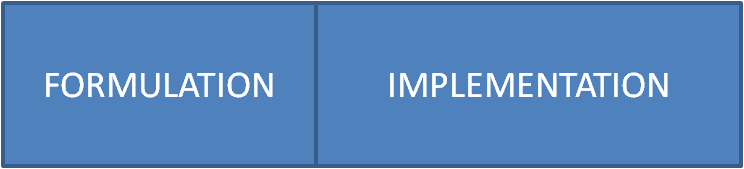
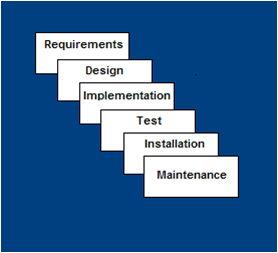
Figure 3.1b Phases in a NASA project life cycle The terms "Key Decision Point (KDP)" and "Gate" are nominally equivalent. The term "transition criteria" may signify an event which, when satisfied, allows a KDP or gate to be "passed" through. The NASA life cycle for Information Technology and Institutional Infrastructure projects follow a similar model as described in NPR 7120.7, NASA Information Technology and Institutional Infrastructure Program and Project Management Requirements. The Generic Software Life Cycle A generic life cycle model for software development, which is aligned to the NASA project life cycle, is shown in Figure 3.2. Concepts and Requirements are part of the common Formulation phase, while Design, Code & Test, and Release & Maintenance are part of the Implementation phase. Figure 3.2 Phases of a generic software development life cycle Once customer needs and concepts are defined, requirements development and management begins in the Formulation part of the software development life cycle and extends into the late Implementation phases for final builds. Software design begins after the Software Requirements Review, includes an intermediate Software Preliminary Design Review, and concludes with a software design being baselined at the Software CDR. Initial and final coding, unit and integration testing, and software documentation, acceptance, and delivery dominate the Implementation period. Typical work products resulting from the requirements phase include the Software Management Plan (see SWE-013 and SWE-102), the Software Requirements Specification (see SWE-049 and SWE-109), and the Requirements Traceability Matrix (see SWE-052). The project specifies KDPs when selecting the type of approved software life cycle (see paragraph 3.3 of NPR 7120.8) to be used on the project. NPR 7123.1A and NASA/SP-2007-6105, NASA Systems Engineering Handbook, Types of Software Life Cycles The project must select and document the life cycle(s) to be used for software development activities. A particular project may require a variety of software development activities. As a result, several types of software development life cycle models may be used during the course of a project to accomplish the various components of the software. The following are examples of software development life cycle models. For more information on the strengths and weaknesses of many of the following example software development life cycles, see Petlick, J., Software Development Life Cycle (SDLC). • The Standard Waterfall Life Cycle
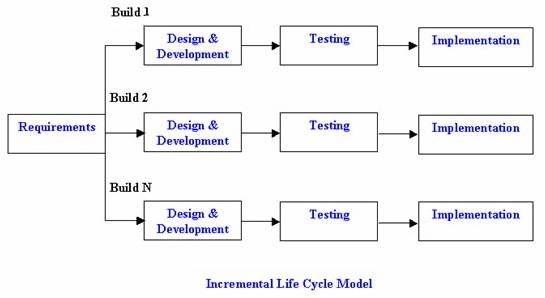
Figure 3.3a Schematic of Standard Waterfall Model The standard waterfall model performs well for work products with clearly understood requirements. • The Standard Incremental Life Cycle Figure 3.3b Schematic of Standard Incremental Life Cycle Model Each build has its own set of requirements, design, code, test, and integration activities. The Incremental life cycle requires that the full system design be completed early and that module interfaces be well-defined. This life cycle works best when most requirements are known early, but allows those requirements to evolve over time. • The Evolutionary (iterative) Life Cycle • The Standard Spiral Life Cycle
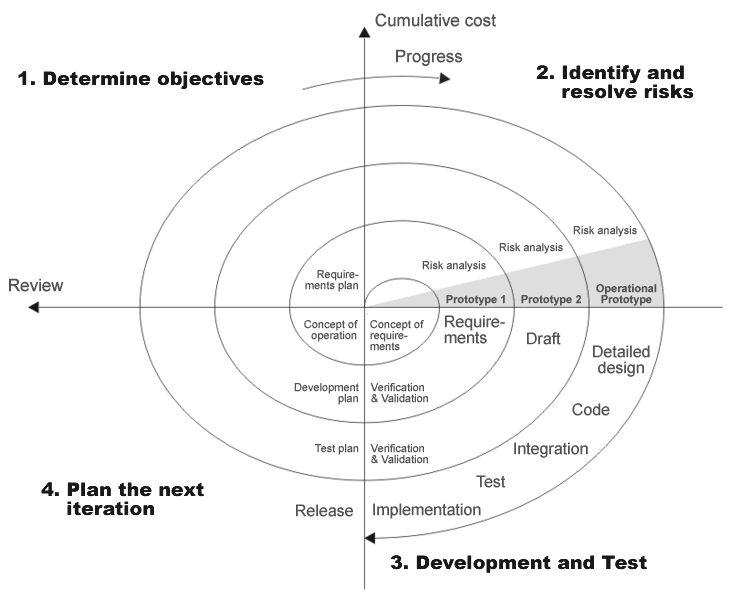
Figure 3.3c Schematic of Standard Spiral Model The spiral model can be visualized as a process passing through some number of iterations, with a four quadrant diagram being used to represent the four phases. Software is produced in the engineering phase. Testing, when it begins, also occurs in the engineering phase of the life cycle model. In the visualization, the angular component of the spiral represents progress, while the radial component represents time and/or cost. The software development process using the spiral approach will pass iteratively through each of these phases until the work product is complete with all requirements and stakeholders being satisfied. The spiral life cycle is typically used when requirements are not well understood or are extremely complex and prototype software can be used to help flush out firmer requirements. • The agile development method Tailoring of Life Cycles Individual projects developing software may benefit by tailoring the basic elements, the key decision points, the major review events, and/or the major work products that are to be developed in each phase of the chosen life cycle. The software development lead determines the appropriate life cycle, along with any modifications, that aligns its efforts with the needs of the overall project. The reviews and work products that arise from a tailored life cycle need to be integrated with the overall project life cycle to maintain schedule consistency. The decision to use a tailored software development life cycle does not affect the requirements specified for the software work products. Any needed modifications or inconsistencies caused by the decision to use a modified life cycle model must be managed by the corrective action and change control processes (see SWE-025 and SWE-053). Additional guidance related to the software development life cycle may be found in the following related requirements in this Handbook:
|


4. Small ProjectsSmaller projects may consider less formal approaches to the life cycle model concept. The agile approach, which relies on testing and feedback, may be more suitable to a smaller project. |
5. Resources |
6. Lessons LearnedNo Lessons Learned have currently been identified for this requirement. |