2. DefinitionsIn the context of this view of the SWEHB, some definitions are in order. These are ideas for helping partition the information so it can be organized in a way to make finding things easier. 2.1 ActivityGeneral name for a set of processes, performed by one or more groups of stakeholders in the development life cycle of a software product. Activity names may align with project phases in some cases depending on the development process or life cycle chosen for the project. Some activities are performed in a sequence. Others may be started and continue while others start up later and run in parallel with other activities. An example of this is coding and testing. These activities may appear to run together while different portions or releases of the code are being developed. An activity is composed of:
2.2 "SWE" ComponentsEach SWE requirement is composed of one or more objectives that represent an industry best practice that OCE expects projects (on the agency in the case of Institutional Requirements) to perform. How these objectives are achieved is at the discretion of the group satisfying the requirement. Each SWE page lists some tasks that would accomplish the requirement, and guidance on how they might be completed. Tasks for the Software Engineering (tab 3? - to be defined) as well as Software Assurance (tab 7) are listed. In cases where additional support or more in depth guidance is available, the reader is referred to a Topic. 2.3 "Supplementary Materials" Other SWEHB ComponentsAny page in the SWEHB that contains guidance on performing a process, such as
The SWEHB Topics page could be expanded to organize and present more groupings of topics. Numbering of topics allows existing reference management macros to be used in the Resources tab of the topic. 2.4 Topics and Topic NumbersIn the first SWEHB (space: 7150) there was only a topic group of 7.xx. The topics were all oriented for Software Engineering. Anything that was not a SWE page was a Topic page and numbered appropriately.
As we built the next version, SWEHBVB, there were still only Software Engineering topics in the 7.xx group. The Topic 7.18 was built to account for a number of SWEs related to minimum document content being retired. While the SWE was retired, the document and its minimum content was retained. All 19 pages now had to be assigned search keys for references and the code for building the reference lists had to be hard coded. When SWEHBVC was built, the Topics page was expanded to contain several more groups of topics:
Additionally, topic 8.16 was built. Some of the document contents from 7.18 were migrated over to 8.16. All of these document pages had search keys and hardcoded reference table code. Adding to the complexity of the problem, these pages were expanded to contain more than just the minimum document content. For example:
Topic 8.16 is growing and branching out to contain a collection of different elements: Minimum Contents of Documents, Analysis Techniques. We need to look at how Topics (or Supplementary Materials) are being built and ensure that they stay focused while still allowing flexibility in how they are designed and built. In the table below, I have organized it in Topic Series number order. Rows in green highlight are currently in use. There are several added number series to account for specific types of topics. We may not implement all of these but a few may be necessary in the short run. Components might include:
2. Topic Renumber Tracking
|
3. Distribution of Chapter 2 SWEs - Complete - See Tab 4The SWEs from NPR 7150.2D chapter 2 are the Institutional Requirements. Initially, I grouped them into 7 "activities" to make sure that they didn't fall out of the overall activity scheme. The table below is the result of that work. SWEs that come from chapter 2 represent things that are done at the Institutional level to enable projects to perform a SWE at the project level. In a sense, they are enabling SWEs. Additional activities were derived from chapter 2 and are highlighted blue below as the first 7 activities. These chapter 2 activities were then copied into the activities in tab 1, highlighted in yellow, where they seemed most likely to belong.
|
4. Activity GroupingsThis tab contains the new table of Activities based on our agreement with Tim's input.
4.1 Activity Pages - Built from the Group's listSee A.00 Activity View in SWEHBVD for the list of activities 4.2 Activities based on Tim's EmailSee A.00 Activity View in SWEHBVD for the list of activities |
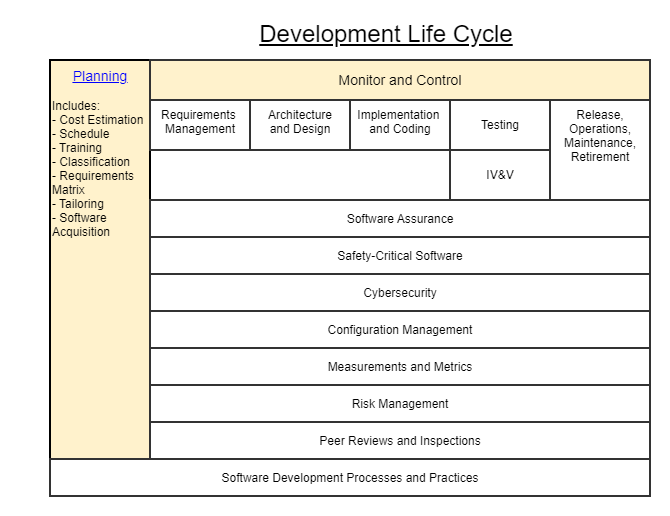
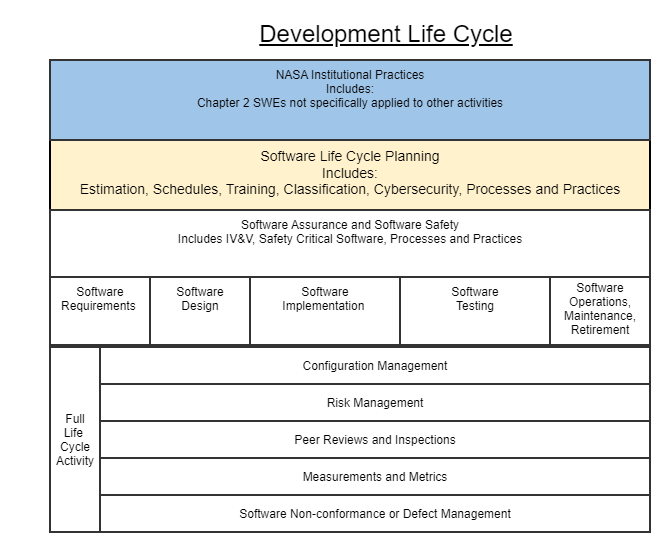
5. Activity Diagram - See Diagram in "A.00 Activity View pageThis activity Diagram represents the SWEHB Activities and their layout on a timeline. The timeline is notional and only represents the predecessors and successors and not any iterations that might be necessary in the real world. 5.1 Diagram in A.00 Activity ViewDiagram with live links is in the page A.00 Activity View tab 1. 5.2 - Fred's Initial Rough Cut Of Activity Groupings In A DiagramGliffy diagrams plugin has been fixed. One of the greatest benefits of Gliffy diagrams is the ability to embed a link in the diagram. I will use this diagram to experiment with Gliffy capabilities. Eventually, a diagram similar to this one will be used to give users a visual representation of the Activity View of SWEHB.
5.3 Tim's Activities in a Diagram
|
6. Activities used in SPANOne element that should probably be in each activity is a link to the SPAN page where more information about the Activity from the Center perspective can be seen. 6.1 Bi-directional Traceability - Between SWEHB and SPAN
This is a list from SPAN of Activities used in various Center Process Asset Libraries. Each of the SPAN Activity pages contains a link to the SPAN Library page where Links to Center libraries are listed that are relevant to the activity. Each Center maintains their libraries. Each Center library contains only those assets which the Center has decided to share outside of the Center. The description of the page, includes a brief statement of the contents, the requirement group from NPR 7150.2 which is applicable, and the applicable SWEHB Activity. 6.2 Activity Groupings in NPR 7150.2 but not explicitly in SPAN
|
7. Design DecisionsEdit: 7. Design Decisions |