1. IntroductionTypically starts with a quote from the NPR that helps define the activity. Additional descriptive material is meant to help define the activity but not be so detailed that it pulls in all of the guidance from the SWEs in the activity. |
 Software peer reviews and inspections are the in-process technical examination of work products by peers to find and eliminate defects early in the life cycle. Software peer reviews and inspections are performed following defined procedures covering the preparation for the review, the review itself is conducted, results are recorded, results are reported, and completion criteria is certified. When planning the composition of a software peer review or inspection team, consider including software testing, system testing, software assurance, software safety, software cybersecurity, and software IV&V personnel. Software peer reviews and inspections are the in-process technical examination of work products by peers to find and eliminate defects early in the life cycle. Software peer reviews and inspections are performed following defined procedures covering the preparation for the review, the review itself is conducted, results are recorded, results are reported, and completion criteria is certified. When planning the composition of a software peer review or inspection team, consider including software testing, system testing, software assurance, software safety, software cybersecurity, and software IV&V personnel.
|
Activity graphical representation of Inputs, Outputs, Predecessor and Successor Activities as appropriate. Not meant to be exhaustive, but representative of a typical project. |
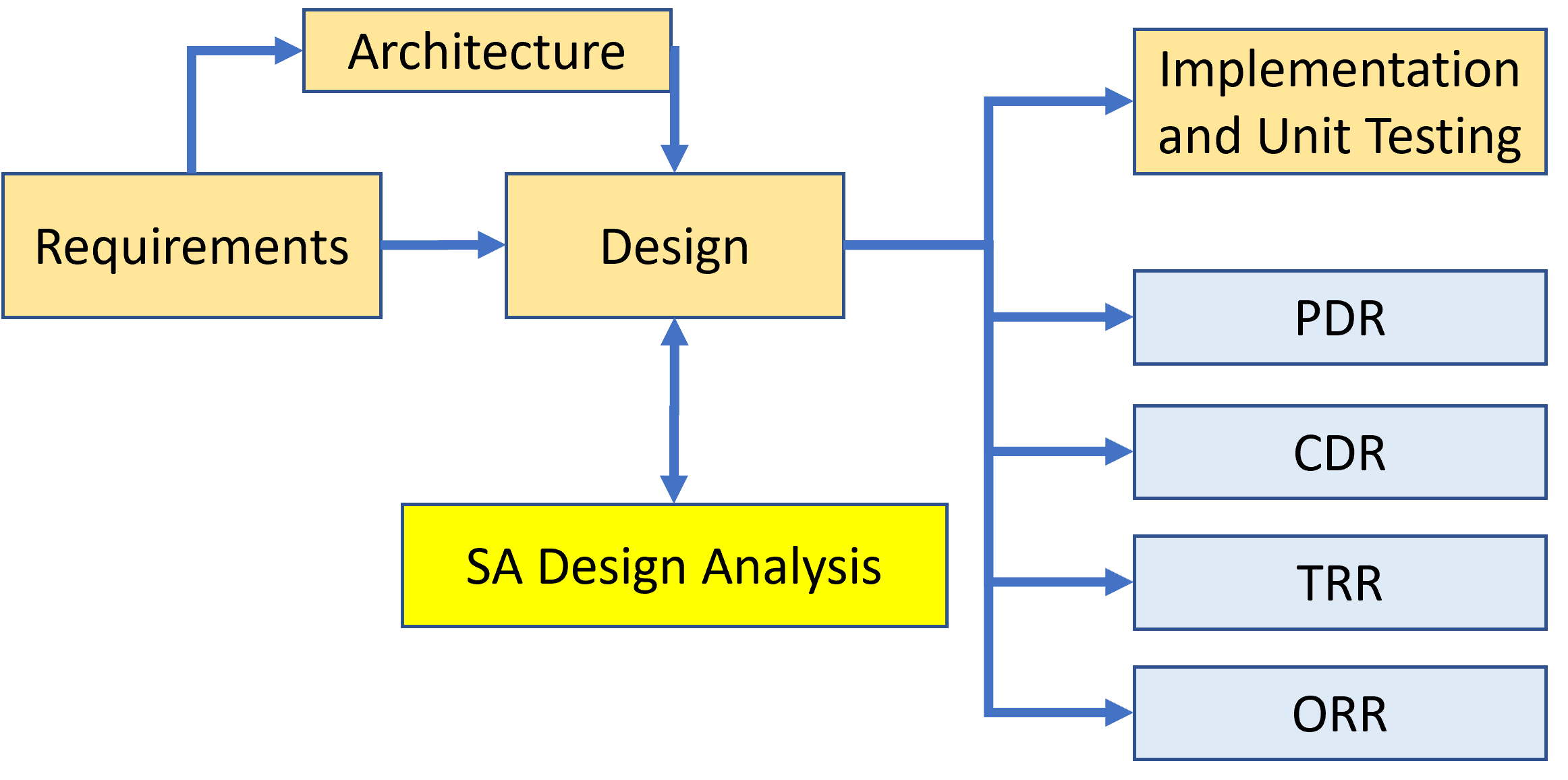
1.1 InputsList of some of the inputs from other activities that are necessary for the activity to begin. |
Examples: - Requirements - These influence the design of the software
- Architecture Documents- These influence the design of the software
1.2 Predecessor ActivitiesList of some of the other activities that must be started (not necessarily completed) so that this activity may begin. |
Examples: Predecessor Activities are performed before Peer Reviews. These activities produce the work products that will be reviewed. - Life Cycle Planning - Design activities are included in the plan and schedules
- Software Requirements - These influence the design of the software
- Software Architecture - These influence the design of the software
1.3 OutputsList of some of the outputs or work products of the activity. These are typically used as inputs by the downstream activity. In some cases there is a supporting SWE associated with the work product. |
| Output Work Product | Used by Downstream Activity |
|---|
| - Implementation and Unit Testing
- Preliminary at Preliminary Design Review
- Baselined at Critical Design Review
- Updated at Test Readiness Review
| | - Implementation and Unit Testing
- Preliminary at Preliminary Design Review
- Baselined at Critical Design Review
- Updated at Test Readiness Review
| | - Implementation and Unit Testing
- Baselined at Operational Readiness Review
|
1.4 Successor ActivitiesLinks to Activities which might be started or supported by this activity. |
- Implementation and Unit Testing - Implements the Design into one or more code modules.
- Preliminary Design Review
- Critical Design Review
- Test Readiness Review
- Operational Readiness Review
1.5 Activity RepetitionDescribe what conditions determine if the activity needs to be repeated, such as re-planning after a change in requirements or schedule constraints. - How much of the activity needs to be repeated
- Frequency of repetition
|
- Design is always done once. It should be peer reviewed and analyzed by Software Assurance.
- Design may be reviewed and re-analyzed as often as there are significant changes in architecture or requirements. For example:
- Technology changes to the architecture requires changes to the design
- Customer changes to requirements require changes to the design
1.6 Center Resources From SPANAdd links to SPAN activity pages that are appropriate for this activity. Use links from the Activity section of the front page. SPAN |
Several Centers Process Asset Libraries have materials related to this activity. Related Processes, templates, and other resources may be found in the following Activities in SPAN (available to NASA only).
|
2. Software Development ActivityThis tab contains the links to pages in the SWEHB that are at the heart of the activity. |
2.1 SWEsThis section contains the links to SWE pages that form the heart of the activity. For each SWE, the related tasks from tab 4 are listed. |
- Copy of SWE-058 - Detailed Design with new tab 4
 - Tasking
- Assess Design Readiness
- Establish Coding Standards and Processes
- Establish Project Specific Design Considerations
- Establish Detailed Design Documentation and Progress Reviews
- Establish Design Maintenance Processes and Mechanisms
- Work Products
- Software Development Process - which includes details on the Design Process to be followed.
- List of design components including when they are expected to be available - as input to Development Schedule
- List of methods, tools, standards, and guidelines for your project.
- List of training and experience required by team members to perform the design and development work.
- ....
- Metrics
- # of architectural issues, found in peer reviews, identified vs. number closed.
- # of design issues, from peer reviews, found versus the number of design issues resolved.
- # of requirement issues (Open, Closed) over time.
- # of non-conformances identified found versus resolved.
- # of software work product Non-Conformances identified versus closed.
2.2 Topics and other Supporting MaterialsThis section is for SWEHB pages, other than SWEs, that directly support the activity. This section contains Topics, document structure pages, PATs, and other relevant pages. |
2.2.1 Topics2.2.2 Document Structures2.2.3 Supporting Materials2.3 Other Associated SWEs, Topics, etc.Includes other SWEHB pages that are indirectly associated with the activity. May include SWEs, Topics, document definition pages, PATs, etc. They may have been mentioned in the guidance of another page. This section may be removed if there is no content for it. |
|
3. Software Assurance ActivitySoftware Assurance is integral to the performance of all Software Development activities. It includes Process Monitoring as well as Process Analysis. - Process Monitoring - addresses the question, "Is the development team following their processes and producing the expected work products?"
- Process Analysis - addresses the question, "Are there better ways of performing the processes that would result in the early discovery of defects?"
3.1 Software Assurance Tasks from SWEsSoftware Assurance Tasks are included in tab 7 of the SWEs in this activity. - Software Assurance Products
- Software Design Analysis
- Results of software assurance design analysis, including assessments in Tasks 1, 2, and 3.
- List of any identified design risks and issues.
- Metrics
- # of architectural issues identified vs. number closed.
- # of design issues found versus the number of design issues resolved.
- # of safety-related requirement issues (Open, Closed) over time.
- # of safety-related non-conformances identified by life cycle phase over time.
- # of software work product Non-Conformances identified by life cycle phase over time
3.2 Topics and Other Supporting Materials3.2.1 Topics3.2.2 Process Asset Templates3.3 Other Associated SWEs, Topics, etc.Includes other SWEHB pages that are indirectly associated with the activity. May include SWEs, Topics, document definition pages, PATs, etc. They may have been mentioned in the guidance of another page. This section may be removed if there is no content for it. |
|
|