bannerd

Versions Compared

Key

  • This line was added.
  • This line was removed.
  • Formatting was changed.

UNDER CONSTRUCTION

1. Introduction

Initiation and Planning activities occur at the beginning of a project.

A project may be for the creation of a new product, or the enhancement of an existing product. It may even involve the merging of capabilities from multiple products into a new, more capable product. It is always necessary to have an understanding of what the outcome of the project is. This is often called the High Level Requirements. These requirements set direction for the project.  Once the direction is set, an early activity is the Make, Buy or Reuse decision. 

2. Initiation and Planning

3.1 Software Life Cycle Planning

SWE-033 - Acquisition vs. Development
                   Assessment
 
SWE-013 - Software Plans

SWE-024 - Plan Tracking 
SWE-034 - Acceptance Criteria
SWE-036 - Software Process Determination
SWE-037 - Software Milestones
SWE-039 - Software Supplier Insight
SWE-040 - Access to Software Products
SWE-042 - Source Code Electronic Access
SWE-139 - Shall Statements
SWE-121 - Document Tailored Requirements
SWE-125 - Requirements Compliance Matrix
SWE-027 - Use of Commercial, Government,
                   and Legacy Software

Tabsetup
01. Introduction
12. Initiation and Planning
23. Estination
34. Schedules
45. Training
56. Classification
6Assurance and Safety
7Coding
89. Cybersecurity
910. Scope
Defining the Activity
Div
idtabs-1

1. Introduction

Note

Typically starts with a quote from the NPR that helps define the activity. Additional descriptive material is meant to help define the activity but not be so detailed that it pulls in all of the guidance from the SWEs in the activity. 

Panel
borderColorblue
titleNPR 7150.2B para 5.3.1

Software peer reviews and inspections are the in-process technical examination of work products by peers to find and eliminate defects early in the life cycle. Software peer reviews and inspections are performed following defined procedures covering the preparation for the review, the review itself is conducted, results are recorded, results are reported, and completion criteria is certified. When planning the composition of a software peer review or inspection team, consider including software testing, system testing, software assurance, software safety, software cybersecurity, and software IV&V personnel.


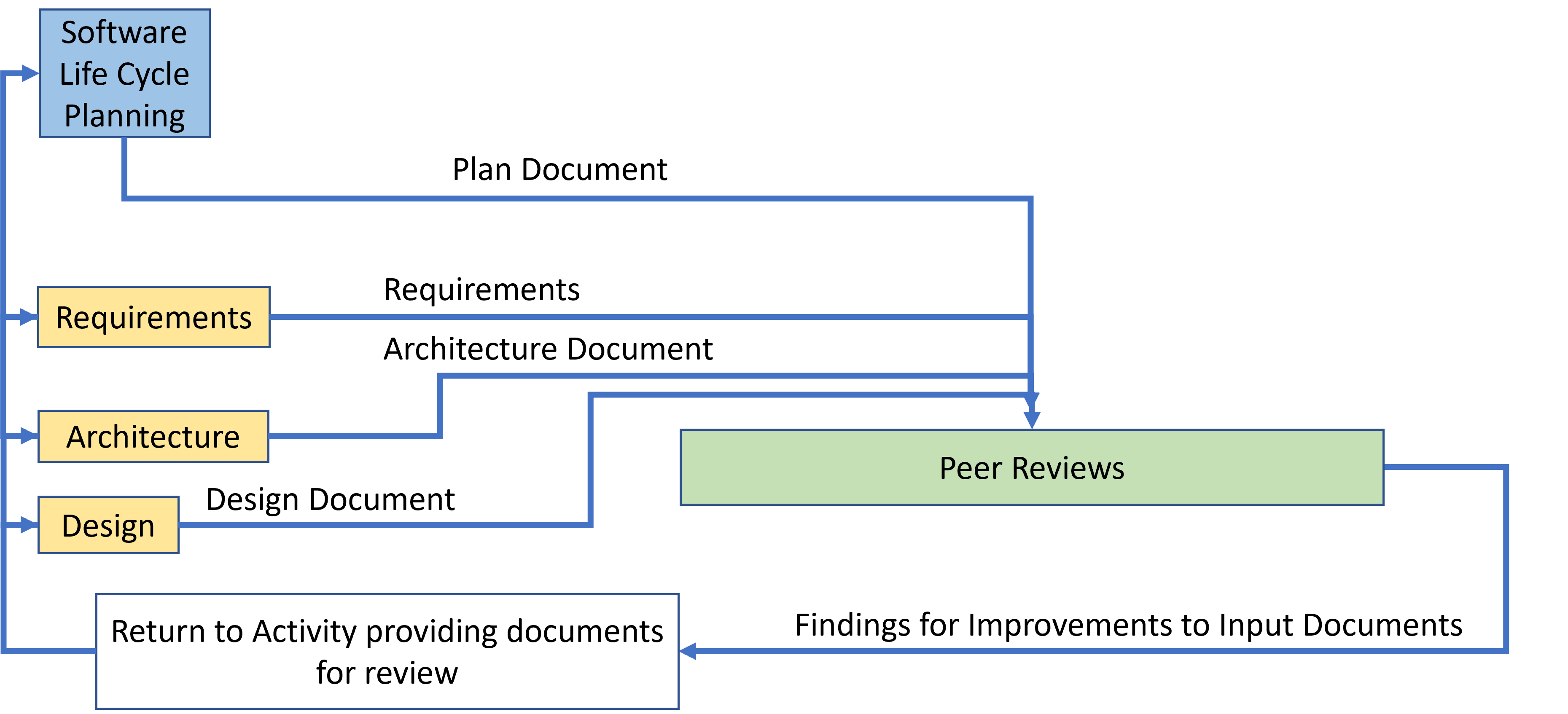
Examples of Some Documents Going Through Peer Review 

Image Added

1.1 Inputs

Note

List of some of the inputs from other activities that are necessary for the activity to begin. 

  • Planning - Peer Reviews are planned activities. They appear in the plans and schedules for the project
  • Requirements - These are the things that are Peer Reviewed
  • Architecture Items - These are the things that are Peer Reviewed
  • Design items - These are the things that are Peer Reviewed
  • Test Plans and Procedures - These are the things that are Peer Reviewed

1.2 Predecessor Activities

Note

List of some of the other activities that must be started (not necessarily completed) this activity to begin. 

Predecessor Activities are performed before Peer Reviews. These activities produce the work products that will be reviewed. 

  • Life Cycle Planning - Peer Reviews are planned activities. They are also used to review and improve all types of plans. 
  • Requirements -  Creating the things that are Peer Reviewed
  • Architecture Items - Creating the things that are Peer Reviewed
  • Design items - Creating the things that are Peer Reviewed
  • Test Plans and Procedures - Creating the things that are Peer Reviewed

1.3 Outputs

Note

List of some of the outputs or work products of the activity. These are typically used as inputs by the downstream activity. In some cases there is a supporting SWE associated with the work product. 

In the case of Peer Reviews, outputs cycle back to the activity that provided the inputs so that improvements to the work products can be made. The activities that initiated the Peer Review, receive the findings from Peer Reviews, Those activities then use those findings to to fix defects and implement improvements uncovered in the reviews. The improved work products are then used by downstream activities as the project proceeds. 

Output Work ProductUsed by Downstream Activity
  • Peer Review Findings
  • Life Cycle Planning
  • Software Architecture 
  • Software Design
  • Software Testing
  • Configuration Management
  • Coding


1.4 Successor Activities

Note

Links to Activities which might be started or supported by this activity. 

  • Life Cycle Planning
  • Software Architecture 
  • Software Design
  • Software Testing
  • Configuration Management
  • Coding

1.5 Repetition

Note

Describe what conditions determine if the activity needs to be repeated.

  • How much of the activity needs to be repeated
  • Frequency of repetition

Peer Reviews are planned activities and may be repeated as needed throughout the life cycle.

  • As Software Requirements, budgets, schedules, and technology changes are factored into the project, additional Peer Reviews of affected work products may be desirable.  

1.6 Center Resources From SPAN

Note

Add links to SPAN activity pages that are appropriate for this activity. Use links from the Activity section of the front page. SPAN

Several Centers Process Asset Libraries have materials related to this activity. Related Processes, templates, and other resources may be found in the following Activities in SPAN (available to NASA only). 


Div
idtabs-2

2. Defining the Activity

Note

This tab contains the links to pages in the SWEHB that are at the heart of the activity. 

2.1 SWEs

Note

This section contains the links to SWE pages that form the heart of the activity. 

2.2 Topics and other Supporting Materials

Note

This section is for SWEHB pages, other than SWEs, that directly support the activity. This section contains Topics, document content pages, PATs, and other pages. 

2.3 Other Associated SWEs, Topics, etc.

Note

Includes other SWEHB pages that are indirectly associated with the activity. May include SWEs, Topics, document definition pages, PATs, etc. They may have been mentioned in the guidance of another page. 

2.3.1 Process Asset Templates 

Panel
borderColorgreen
titlePeer Reviews Assets Process Asset Templates

Include Page
Peer Review Process Asset Templates

Div
idtabs-1
Div
idtabs-2
Div
idtabs-3

3. Estimation

3.2 Software Cost Estimation

SWE-015 - Cost Estimation
SWE-151 - Cost Estimate Conditions
SWE-174 - Software Planning Parameters

Div
idtabs-4

4. Schedules

3.3 Software Schedules

SWE-016 - Software Schedule
SWE-018 - Software Activities Review
SWE-046 - Supplier Software Schedule

Div
idtabs-5

5. Training

3.4 Software Training

SWE-017 - Project and Software Training

Div
idtabs-6

6. Classification

3.5 Software Classification Assessments

SWE-020 - Software Classification 
SWE-176 - Software Records 

3.9 Software Development Processes and Practices

SWE-032 - CMMI Levels for
                   Class A and B Software

Div
idtabs-7

7. Assurance and Safety 

3.6 Software Assurance and Software
Independent Verification & Validation

SWE-022 - Software Assurance
SWE-141 - Software Independent Verification
                   and Validation
SWE-131 - Independent Verification and
                   Validation Project Execution Plan
SWE-178 - IV&V Artifacts
SWE-179 - IV&V Submitted Issues and Risks

3.7 Safety-Critical Software

SWE-205 - Determination of Safety-
                  Critical Software 
SWE-023 - Software Safety-Critical
                   Requirements 
SWE-134 - Safety Critical Software
                   Design Requirements
SWE-219 - Test Coverage for Safety
                   Critical Software Components

SWE-220 - Cyclomatic Complexity Values
                   for Safety Critical Software

Div
idtabs-8

8. Coding Techniques

3.8 Automatic Generation of Software Source Code

SWE-146 - Auto-generated Source Code 
SWE-206 - Auto-Generation Software Inputs

3.10 Software Reuse

SWE-147 - Specify Reusability Requirements
SWE-148 - Contribute to Agency
                   Software Catalog

Div
idtabs-9

9. Cybersecurity

3.11 Software Cybersecurity

SWE-156 - Evaluate Systems for
                   Security Risks
SWE-154 - Identify Security Risks
SWE-157 - Protect Against
                   Unauthorized Access
SWE-159 - Verify and Validate Risk
                   Mitigations 
SWE-207 - Secure Coding Standard
SWE-185 - Verification of Software Code
                   to Coding Standards
SWE-210 - Detection of Adversarial Actions

Div
idtabs-10

10. Scope Management

3.12 Software Bi-Directional Traceability

SWE-052 - Bidirectional Traceability