

UNDER CONSTRUCTION
 View this section on the website
 See edit history of this section
 Post feedback on this section

1. Introduction
Software Engineering activities are conducted in a predictable sequence. This sequence may be a once through / "waterfall" cycle. Or, it may be an iterative or evolutionary series of cycles which build toward a final product. Regardless of the model chosen, individual activities in all these cycles are very similar.
The major activity groupings here give you a quick way to find guidance in the SWEHB to help you satisfy the needs of the development project while also satisfying the requirements of NPR 7150.2.
The activities associated with Software Engineering are listed in the tabs of this page. Each tab takes you to a list of links to pages where the activity is is explained in more detail. At the lowest level, there is a list of links to specific pages in the SWEHB where details of the activity are explained and more guidance is provided. In some cases, templates or other Process Assets are included to further help you in conducting the activity.
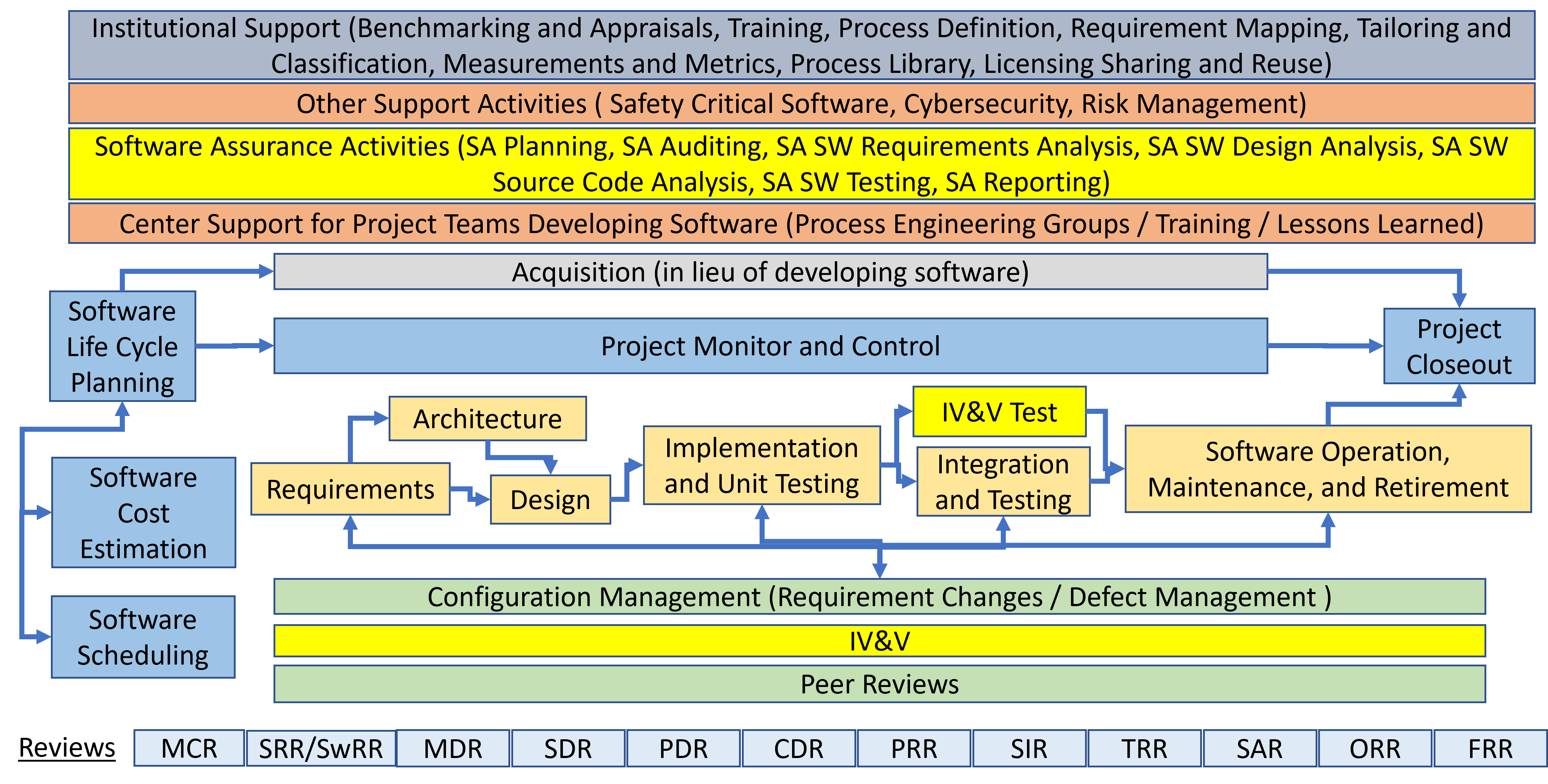
1.1 Activity Groupings
The tabs in this page initially will contain all of the activities in Ch 2 through 5 of NPR 7150.2. This is done to ensure that all SWEs are accounted for.
As the page matures, Topics, PATs, and other resources will be distributed to enrich the content of the activities.
SWEs from NPR 7150.2 are reproduced in a floatbox on the right to ensure that all SWEHB content is accounted for somewhere in the view.
2. Institutional Activities
The Management activities associated with Software Development Projects are listed as links below.
Management activities are typically conducted by those in leadership roles. Supervisors, managers and team leads are involved to varying degrees. Some activities even involve Support, Assurance and Safety roles. Interactions are explained in the activities.
2.1 OCE and OSMA Software Engineering Initiative
Agency Level Activities are intended to provide "enabling support" to project teams. These activities include direction, guidance and support to project teams.
Process Definition
Requirement Mapping and Tailoring
Measurements and Metrics
Benchmarking
Provide Training
Process Library
Licensing, Sharing and Reuse
3. Management
The Management activities associated with Software Development Projects are listed as links below.
Management activities are typically conducted by those in leadership roles. Supervisors, managers and team leads are involved to varying degrees. Some activities even involve Support, Assurance and Safety roles. Interactions are explained in the activities.
This tab includes SWEs from ch 2 and 3.
3.1 SE-Initiation and Planning
3.1 Software Life Cycle Planning
SWE-033 - Acquisition vs. Development
Assessment
SWE-013 - Software Plans
SWE-024 - Plan Tracking
SWE-034 - Acceptance Criteria
SWE-036 - Software Process Determination
SWE-037 - Software Milestones
SWE-039 - Software Supplier Insight
SWE-040 - Access to Software Products
SWE-042 - Source Code Electronic Access
SWE-139 - Shall Statements
SWE-121 - Document Tailored Requirements
SWE-125 - Requirements Compliance Matrix
SWE-027 - Use of Commercial, Government,
and Legacy Software
3.9 Software Development Processes and Practices
SWE-032 - CMMI Levels for
Class A and B Software - Benchmarking
3.2 SE-Estimation
3.2 Software Cost Estimation
SWE-015 - Cost Estimation
SWE-151 - Cost Estimate Conditions
SWE-174 - Software Planning Parameters
3.3 SE-Schedules
3.4 SE-Training
3.4 Software Training
3.5 SE-Classification
3.5 Software Classification Assessments
SWE-020 - Software Classification
SWE-176 - Software Records
3.6 Cybersecurity
3.11 Software Cybersecurity
SWE-156 - Evaluate Systems for
Security Risks
SWE-154 - Identify Security Risks
SWE-157 - Protect Against
Unauthorized Access
SWE-159 - Verify and Validate Risk
Mitigations
SWE-207 - Secure Coding Standard
SWE-185 - Verification of Software Code
to Coding Standards
SWE-210 - Detection of Adversarial Actions
4. Engineering
This tab includes SWEs from ch 3 and 4.
4.1 SE-Scope Management
3.12 Software Bi-Directional Traceability
SWE-052 - Bidirectional Traceability
4.1 Software Requirements
SWE-050 - Software Requirements
SWE-051 - Software Requirements Analysis
SWE-184 - Software-related Constraints and
Assumptions
SWE-053 - Manage Requirements Changes
SWE-054 - Corrective Action for
Inconsistencies
SWE-055 - Requirements Validation
4.2 SE-Architecture
4.2 Software Architecture
SWE-057 - Software Architecture
SWE-143 - Software Architecture Review
4.3 SE-Design
4.3 Software Design
4.4 SE-Coding
3.8 Automatic Generation of Software Source Code
SWE-146 - Auto-generated Source Code
SWE-206 - Auto-Generation Software Inputs
3.10 Software Reuse
SWE-147 - Specify Reusability Requirements
SWE-148 - Contribute to Agency
Software Catalog
4.4 Software Implementation
SWE-060 - Coding Software
SWE-061 - Coding Standards
SWE-135 - Static Analysis
SWE-062 - Unit Test
SWE-186 - Unit Test Repeatability
SWE-063 - Release Version Description
SWE-136 - Software Tool Accreditation
4.5 SE-Testing
4.5 Software Testing
SWE-065 - Test Plan, Procedures, Reports
SWE-066 - Perform Testing
SWE-187 - Control of Software Items
SWE-068 - Evaluate Test Results
SWE-070 - Models, Simulations, Tools
SWE-071 - Update Test Plans and
Procedures
SWE-073 - Platform or Hi-Fidelity
Simulations
SWE-189 - Code Coverage Measurements
SWE-190 - Verify Code Coverage
SWE-191 - Software Regression Testing
SWE-192 - Software Hazardous
Requirements
SWE-193 - Acceptance Testing for Affected
Behavior
SWE-211 - Testing Levels of Non-Custom
Developed Software
4.5.1 Unit Testing
(from 4.4 Software Implementation)
SWE-062 - Unit Test
SWE-186 - Unit Test Repeatability
4.5.2 Integration Testing
4.6 Operation Maintenance and Retirement
4.6 Software Operations, Maintenance,
and Retirement
SWE-075 - Plan Operations, Maintenance,
Retirement
SWE-077 - Deliver Software Products
SWE-194 - Delivery Requirements
Verification
SWE-195 - Software Maintenance Phase
SWE-196 - Software Retirement Archival
SWE-075 - Plan Operations, Maintenance,
Retirement
4.6.1 Release of Software
This means "for use" by other mission teams to integrate into larger systems.
SWE-063 - Release Version Description
SWE-136 - Software Tool Accreditation
SWE-077 - Deliver Software Products
SWE-194 - Delivery Requirements
Verification
4.6.2 Use of Software in Operations
4.6.3 Maintenance of Software
SWE-195 - Software Maintenance Phase
4.6.4 Retirement of Software
5. Assurance
This tab includes SWEs from ch 3.
5.1 SA-Assurance
3.6 Software Assurance and Software
Independent Verification & Validation
SWE-022 - Software Assurance
SWE-141 - Software Independent Verification
and Validation
SWE-131 - Independent Verification and
Validation Project Execution Plan
SWE-178 - IV&V Artifacts
SWE-179 - IV&V Submitted Issues and Risks
5.2 Safety
3.7 Safety-Critical Software
SWE-205 - Determination of Safety-
Critical Software
SWE-023 - Software Safety-Critical
Requirements
SWE-134 - Safety Critical Software
Design Requirements
SWE-219 - Test Coverage for Safety
Critical Software Components
SWE-220 - Cyclomatic Complexity Values
for Safety Critical Software
6. Support
This tab includes SWEs from ch 5.
6.1 Configuration Management
6.2 Risk Management
5.2 Software Risk Management
6.3 Peer Reviews and Inspections
6.4 Performance Measurements
6.5 Non-Conformance and Defect Management
5.5 Software Non-conformance or Defect Management
SWE-201 - Software Non-Conformances
SWE-202 - Software Severity Levels
SWE-203 - Mandatory Assessments for
Non-Conformances
SWE-204 - Process Assessments

0 Comments